A lot of Afghans worked for you – why aren’t you helping them?
Teenage refugee issues plea to Ministry of Defence to help his brothers escape from the Taliban
Friday, 13th February — By Isabel Loubser
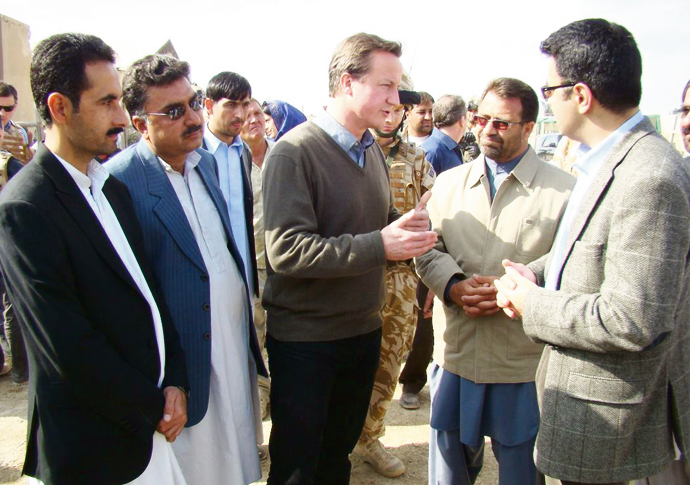
Mr Ahmadi Martindale’s father Daud (second from right), who worked with the British government, with former prime minister David Cameron
A 19-YEAR-OLD Afghan refugee, whose father collaborated with the British government, is pleading with the Ministry of Defence to allow his elder brothers to escape the Taliban by coming to the UK.
Maiwand Ahmadi Martindale, who now lives in Crouch Hill, fled his home country, along with his parents and younger siblings, in 2024.
Mr Ahmadi Martindale’s father, Daud Ahmadi, was the spokesperson for the Helmand governor from 2008 until 2012, during which time he met both Gordon Brown and David Cameron.
Helmand, which was under British military control, was Afghanistan’s most dangerous province during the fighting. Hundreds of British soldiers were killed there alongside thousands of Afghan civilians.
“When you wanted to go out from the house, you wouldn’t know if you were coming back,” said Mr Ahmadi Martindale. “Because there were bombs, people have weapons. From 2009 to 2019 there was killing, killing, killing.
“I had 20 friends die in the war.”
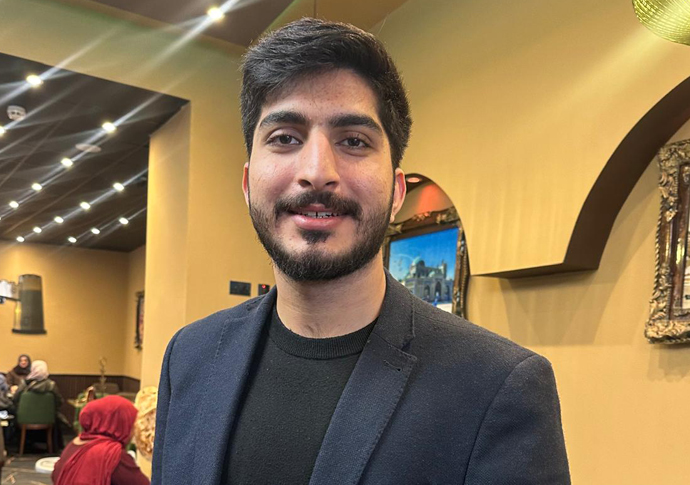
Maiwand Ahmadi Martindale
When American and international troops withdrew in August 2021, the Taliban re-took control of Afghanistan in just 10 days.
Tens of thousands of Afghans fled from their homes to Kabul, while President Ashraf Ghani left the capital, and the British began to evacuate those who had supported international efforts and could be at risk.
For Mr Ahmadi Martindale and his family, however, they would have to wait another two years before escaping the danger they were facing in their home country.
In the chaos of the Taliban re-capture, they could not make it onto the emergency flights out of Kabul, and instead, were forced into hiding.
The family was barely able to leave the house, and when they did it was in disguise and in the dark.
During this time, when the Taliban was trying to track down anyone who had worked with international authorities, two of the brothers claim to have been caught, held, and tortured by the security arm.
It was in this context that the UK began its Afghan Relocations and Assistance Policy (ARAP) to resettle those who had helped British forces in the UK.
Mr Ahmadi Martindale’s father made a successful application under the scheme, but was only allowed to bring his wife and children under the age of 18 with him.
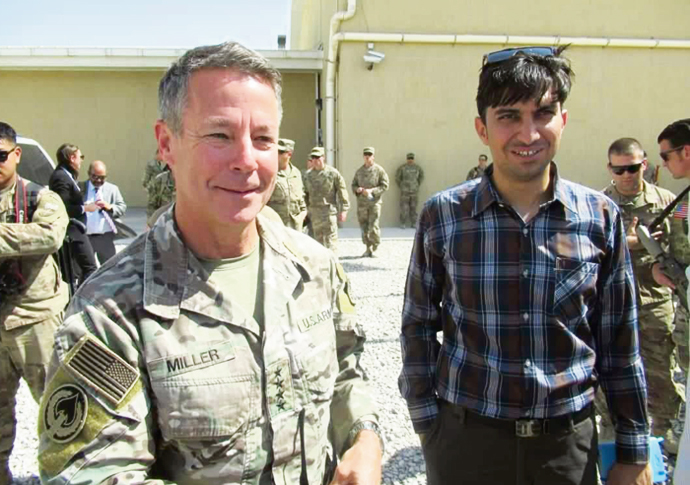
General Austin Miller with Mr Ahmadi Martindale’s brother Ahmad
His remaining seven children – who were still living with him in the family home – were barred from entering the UK.
“I feel angry when they rejected my family members. It is not right”, Mr Ahmadi Martindale told the Tribune. “After someone has worked with you, not only my family, a lot of Afghans worked with you, you have to take them out.”
He added: “We have been pleading with the Ministry of Defence. They took the risk, for your government. They killed the Taliban for your name, why aren’t you helping them?”
His brothers, one of whom also worked for the government before the US withdrew troops in 2021, are now in hiding in their home region of Khandahar.
In letters seen by the Tribune, the General Directorate of Intelligence, the security arm of the Taliban, has declared that they are in “serious pursuit” of Mr Ahmadi Martindale’s family.
“We have learned that Mohammad Daud himself has fled to a foreign country, but his treacherous friends are hiding”, the letter adds.
Mr Ahmadi Martindale’s family has written to the Ministry of Defence, with evidence of the threats, but say they have been told that the siblings are not at risk. “I speak to my brothers, they are very scared. They are in danger”, said Mr Ahmadi Martindale.
It is understood that the MoD is currently reviewing an appeal about the ineligible decision but it would not comment specifically on the individual case.
