A stitch in time: how Bayeux Tapestry offers an important reminder of the nuances of history
Back in Blighty after a thousand years, the Bayeux Tapestry has found its way to the British Museum. Dan Carrier unravels 1066 and all that
Thursday, 10th September — By Dan Carrier
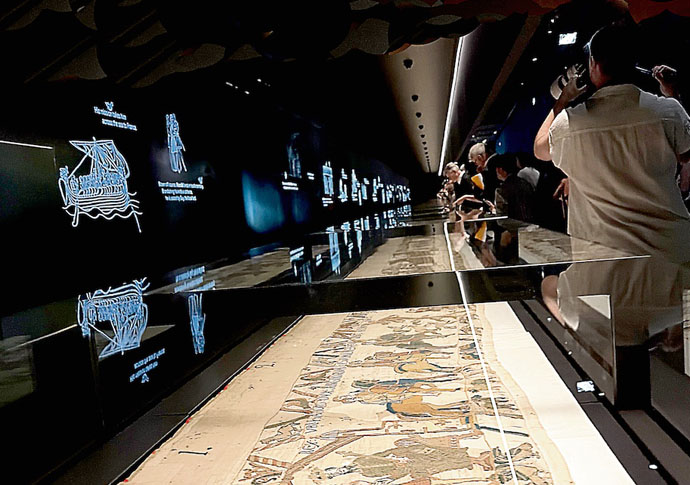
The Bayeux Tapestry – all 70 metres of it – is on display at the British Museum
THEY were packed so tightly that the slain scarcely had space to fall,” wrote William of Poitiers, describing the carnage on a field near Hastings.
It was prompted by an act of betrayal, driven by greed and ambition. The day ended with King Harold dead.
He had taken the throne after the demise of Edward the Confessor, and was not going to give up his title lightly. Norman aristo William had been betrayed – Harold had said he’d support the Frenchman’s claim – and both sides were armed and unwilling to back down.
It would have deadly consequences.
As William of Poitiers wrote: “Soaked in blood, the flower of England’s nobility and youth covered the ground far and wide.”
The 1066 date is a seminal part of our nation’s creation story and it illustrates our national contradictions: concepts of patriotism are often linked to the Royal Family, but as this incident shows, the hereditary head of state is bathed in blood and foreign conquest. There is nothing inherently “English” about it.
As Tom Paine wrote in Common Sense, The Battle of Hastings starts a lineage from a “paltry rascally original,” caused by the victory in battle by a “French bastard landing with an armed banditti”.
Yet the story of the last thousand years of English history begins with William the Conqueror – and that story is best known through the imagery of the Bayeux Tapestry.
This week saw the Tapestry’s first visit London since it was carefully stitched 10 centuries ago: there has been an understandable kerfuffle over the loan, and it is hard not to feel as if you are in the presence of a quasi-religious relic when you enter a darkened Salisbury Wing at the Bloomsbury institute to see it laid out.
The impact of seeing the Tapestry is two-fold: there is the sense of history, the kind of emotion felt when seeing Michaelangelo’s Sistine Chapel or Da Vinci’s Mona Lisa in the flesh. Something so familiar it feels like an old relative.
Then there is the sheer beauty of something made so, so long ago.
While the imagery of two-dimensional Normans is immediately recognisable, looking closely at each scene shows the skill and care taken. It is humbling to think of the hands stitching the wool to the linen.
Some scene-setting is done at the darkened entrance to the show: the 70-metre-long storyboard was made in England, renowned for the skill of its embroiderers: “England’s women are highly distinguished in needlework and embroidering with gold thread,” wrote William of Poitiers in 1071.
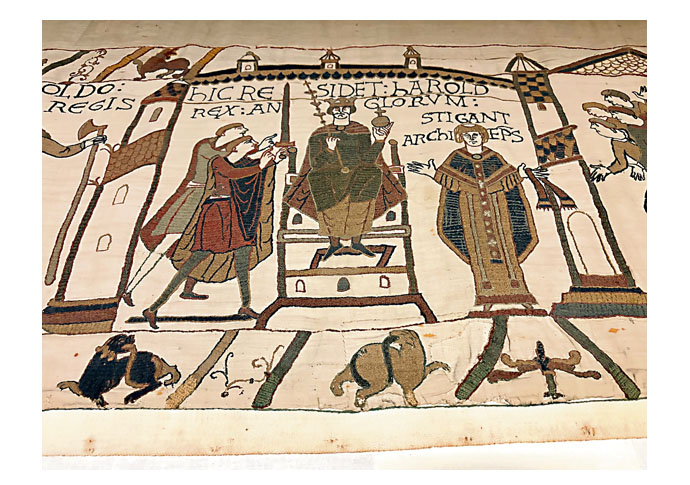
The women told the story of the Conquest via 58 scenes, 626 characters and 202 horses.
We learn Bishop Odo, a Norman who commissioned the work, was “an eloquent and noble man, bountiful and vigorous in pursuit of worldly concerns. He respected religious men earnestly, fiercely defending his clergy with sword and speech. He decorated his church lavishly – with precious ornaments,” a quote from 1114 states.
Edward the Confessor was “of Exceptional height… distinct because of his milky-white hair and beard. His face was full and rosy, his hands thin and snow white, with long translucent fingers… he was agreeable but never undignified,” another 1065 description explains.
The Tapestry, with its Latin explainers, runs from Harold fighting alongside William as a brother-in-arms, at one point heroically saving William’s men from quicksand, and then to the fateful battle.
In between, this woollen storyboard shows Edward’s death in Westminster that led to Harold taking the throne, despite promising he’d support William.
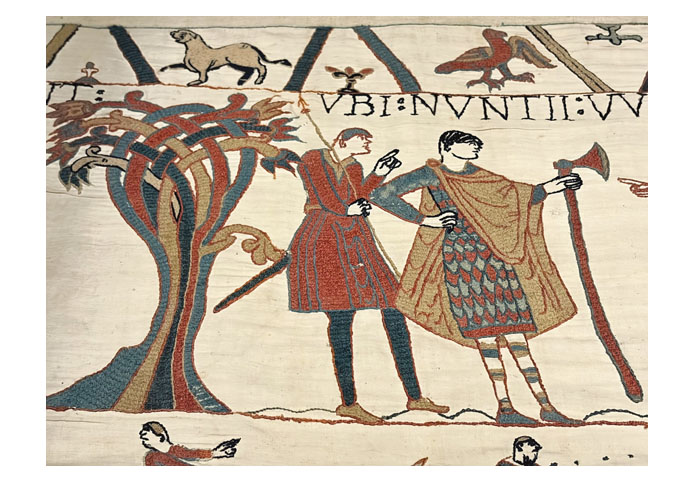
The Tapestry itself is a mix of crude depictions balanced against intricacy. Some parts look like a simplistic Norman cartoon, and then there are parts that have perfect perspective. You feel like you can tell the skill of the individual’s embroidery. It isn’t constant, and that is part of the story of this production.
And it’s not just watching the people wound through the narrative. There are clues to daily life, from clothing and armour to architecture and transport.
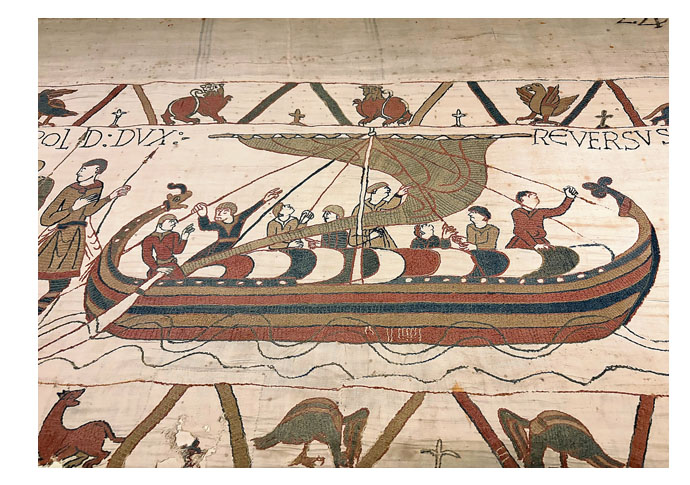
Viking King Cnut had ruled 150 years before Edward the Confessor, whose death prompted the invasion – and the Danish influence in shipping and war materiel is obvious.
The story comes to an end with the French William victorious.
In a time when understanding of nationhood is a fire-blasted political topic, this exhibition is an important reminder of the nuances of history.
There are gaps in the story that remain, and the exhibition, so dazzled by the Tapestry’s undoubted brilliance and historic importance, does not address them.
While there is some scene-setting, it tends to lean towards the martial and monarchial: a collection of weapons and armour at the beginning show the crudity of instruments of murderous intent.
We learn a little about who made it and how, but it’s hard not to come away with the feeling of awe slightly tempered on reflection by the need to know more: who were the people of England, now under the Norman yoke? What was life like? How did they feed and clothe themselves? What did they believe in? How were they governed, and what laws did they follow?
The show has too much an incredible artefact at its heart for there to be space for too many scene-setting peripheries.
Just seeing all 70 metres of linen and wool laid out is enough. It will act as a catalyst for those who see it to want to learn more.
When Howard Carter dug up Tutankhamen’s tomb in 1922, London was gripped by a craze for all things Egyptian – fashion and design drew heavily on it.
It would not be a surprise if we see something similar in the coming months, inspired by the work of a group of women nearly a thousand years ago.
• The Bayeux Tapestry is at the British Museum until July 11, 2027. Next ticket release October 21. www.britishmuseum.org
