Author wants storytelling to be key part of a new chapter in care
Debbie Spain has written more than 40 short stories, designed to be read aloud to older people
Friday, 21st August — By Amy Reid
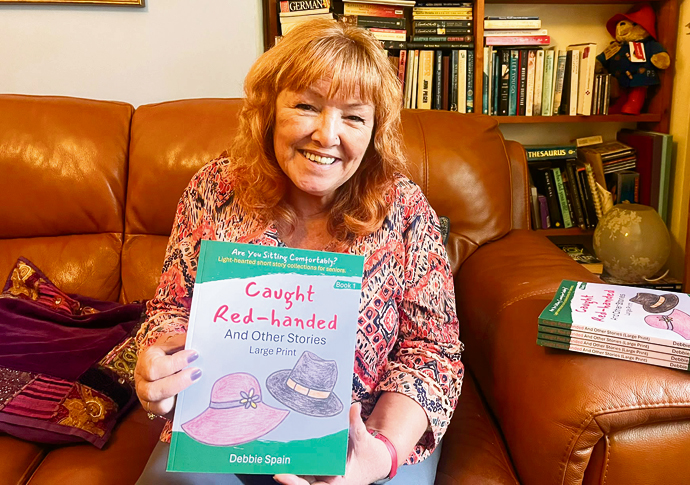
Debbie Spain
A WOMAN is pushing for storytelling to become a recognised part of care home activity schedules after seeing its positive impact on residents with fading memories.
Debbie Spain, 61, has written more than 40 short stories and accompanying illustrations over the past two years, designed to be read aloud to older people.
The stories, all of which she handwrites weekly, involve themes and characters older residents can relate to.
Telling stories to a group or to individual residents in their rooms, she said, creates a space for residents – who may have difficulties with memory – to open up about their lives.
“If you ask them point-blank questions, they may not know, and they might feel upset and embarrassed. But if you say, ‘OK, this guy had a poodle, and then he got gout and he wasn’t able to walk his poodle, and this is what they did living in a tower block’, then someone will say, ‘I had a poodle’, and someone else will say, ‘I had an Alsatian’, and someone else will say, ‘My son lives in a tower block’.”
Ms Spain, who had hardly written before the past two years aside from penning stories about her two Scotty dogs Ruby and Agnes for family and friends, recalls a childhood full of Ronnie Corbett’s story chair segment, Jackanory and Watch with Mother.
She was prompted to write her first story while working as an activities coordinator at a care home. She took the job after the pandemic, but says she has always had jobs that required her to be a “redcoat” of sorts, entertaining co-workers and clients as a sales manager, and being a Slimming World leader and trainer.
To mark National Story Week, Ms Spain wrote Mildred and Muffin in honour of a resident who had a small statue of a ginger tomcat. Since stepping back from her role at the care home due to physical difficulties, she now makes around 10 visits to care homes per month, reading her original stories aloud to residents.
As people age and their energy and memory wanes, they can end up left out of conversations, but storytelling, says Ms Spain, can help soothe this decline.
“They have so much more about them than they don’t,” she told the Tribune. “It’s unbelievable the things they remember. And the things they remember are far more important than the fact that they forgot what they had for lunch an hour ago. That doesn’t mean they don’t have a whole load of stuff they want to tell you.
“The stories bring it about because you’re inviting them to speak about it. It might just be an object, it might be a phrase, it could be anything really, but it will trigger things off with people, then other people start to join in.”
Her hope is that storytelling will become an established activity in care homes. She said: “I really do want storytelling to be everywhere because I’ve just seen how they come to life.”
“I know they enjoy music and singing, but, maybe I’m biased, but I can’t help feeling that telling stories to older people has not been seen as ‘a thing’.”
Last month, Ms Spain self-published 15 of her stories into a printed volume, available to buy on Amazon – Caught Red-Handed and Other Stories – to allow homes and families of residents to read aloud to residents in her absence.
The tales are printed in large type, something that Ms Spain says is a huge barrier to access for older and vision-impaired people reading.
“There are millions of books out there for children and they’re being read to all the time, and I’m finding that older people may not be reading very much themselves any more. Sometimes it’s not very easy to access large print,” she said.
She says her storytelling has also helped care home residents bond with each other. “Very often you’ll find that residents that sit together in communal space aren’t always sure how to begin conversation, even with people they see around every day.
“Even if they didn’t say it to each other straight away, they now know they’ve got something in common.
“I think there are a lot of grandparents and great grandparents who would be only too happy to have that imagination sparked and tell people about their first dog or their first cat,” she added.
