Constable on the beat: how painter was drawn to ‘the lungs of London’
Estelle Lovatt follows in the footsteps of John Constable, who loved Hampstead almost as much as his beloved Suffolk
Thursday, 11th June — By Estelle Lovatt
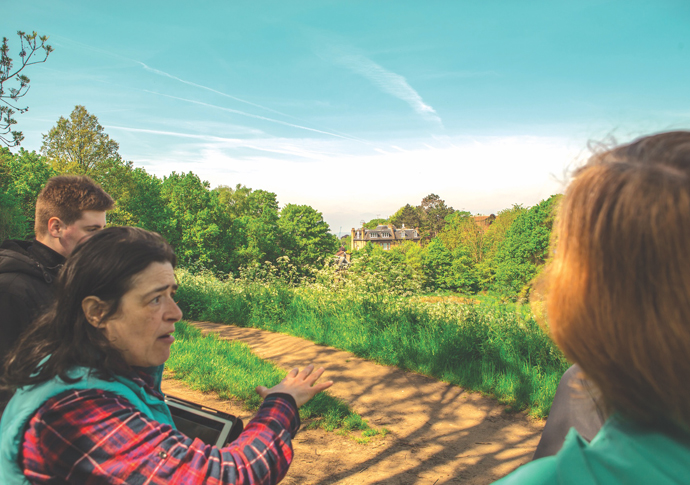
Estelle Lovatt on the Constable trail in Hampstead [Cristina Schek]
IN John Constable’s 250th birthday anniversary year, Hampstead offers an exceptionally enlightening and informative way to re-evaluate the great English Romantic landscape painter’s accomplishments.
Born in East Bergholt, Suffolk, on June 11, 1776, he was drawn to Hampstead by its lush Heath greenery and its early Georgian and Regency architecture. It was here that he painted, sketched, drew, taught and lectured, declaring: “Here, Hampstead, let me take my everlasting rest.”
He first visited Hampstead when he was a student at the Royal Academy. Walking there from central London, he spoke of covering the “three miles from door to door … see nature, and unite a town and country life”. Its rich green verdant landscape reminded him of his family farm and home in Suffolk.
He spent the last 19 years of his life in Hampstead, painting the views that, he said, included “Child’s Hill, fields in Hendon, church spires in Harrow on the Hill, and even Windsor Castle!” He also sketched workhands labouring on the Heath, managing cows, sheep, horses, donkeys and dogs beneath ash, birch, elm, oak and fir trees around the ponds.
At about 450 feet above the city of London, Hampstead stood apart from the crowded, polluted city and offered a sanctuary for Constable’s family, especially his often-unwell wife, Maria. As he put it, “Hampstead is the lungs of London”, with “the finest views, unsurpassed in Europe, from Westminster to Gravesend, Kent, and the dome of St Paul’s” to paint.
Constable wrote that “every day in Hampstead makes me long for a walk”. He favoured the coarser landscape of the Heath to formal stiffly manicured city parks, which he saw as artificial rather than natural. As he said: “the gentleman’s park is my aversion. It’s not beauty because it’s not nature!”
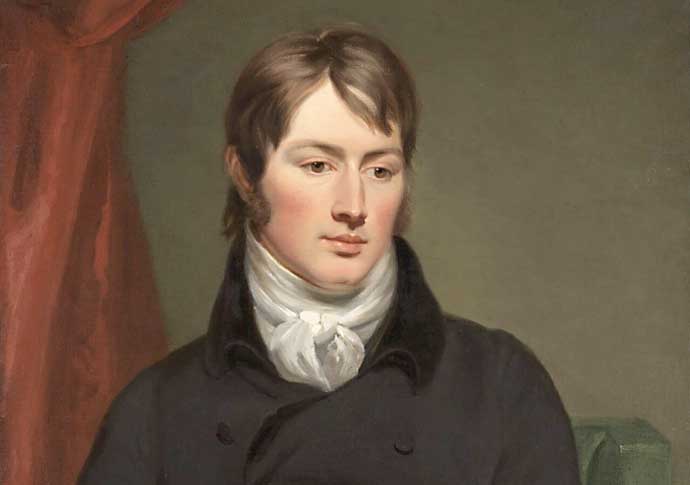
John Constable
He added: “My art is found under every hedge; in every lane – therefore no one thinks it’s worth picking…[But] the landscape is too large to go unnoticed…[and the] Canvas takes the place of God’s work; the landscape is God’s plan in eye; because since the Creation, no two days are alike, no two hours are alike. No two trees are alike. No two leaves are alike.” To communicate that selection of hue, he mixed “a thousand greens to capture the complexity of nature’s beauty.”
While living in Hampstead, Constable advanced some of his most investigational practises, including the cloud studies associated with his famous masterpiece The Hay Wain, 1821, in the National Gallery. Although the painting shows the River Stour and Willy Lott’s house, in Suffolk, it is believed to have been developed from sketches and drawings made near to Whitestone Pond. It was completed in the back garden shed of his Hampstead home, Lower Terrace.
On the Heath and around Whitestone Pond, he studied light, atmosphere and movement with extraordinary liberty and self-determination, shifting direct observation into a new language of landscape painting. His oil paint sketches capture transitory rain showers, drifting vapours, fumes and coal-smoke unsettling the skyline.
These images still feel extraordinarily modern, not only for their wholesomeness of painterly-touch, but because they also seized the weather conditions, as lived experience. Hampstead gave him the visual platform he needed to seize the kaleidoscopic light, surging clouds, church towers in the distance and far-reaching outlooks analysing views across London, all of which sharpened his eye.
The Village streets, sweeping heathland and Constable’s actual painting viewpoints lets one see, feel and live the visual exchange between artist and location. Reminding us how Constable painted not only topography – en plein air, but also memory – back in his studio. Finding godliness and spiritual power deep in English landscape.
Walking where he Constable did is to see how Hampstead became both a safe haven and art studio: a place for family life and artistic experimentation. In Hampstead, the natural world continually charged his artistic imagination, making celebrating Constable’s 250th birthday here feels so significant.
He died in 1837 and is buried with his wife, Maria, and six of their seven their children, in their family tomb at St John’s Parish Church, Church Row, Hampstead.
• To book tickets for Estelle Lovatt’s Constable’s Hampstead Walk on June 28 see www.estellelovatt.com or www.eventbrite.com/o/34402021167
