Neighbours split on bulldozing Lee Cooper jeans founder's former Hampstead ‘bungaloid'
Friday, 18th September 2015
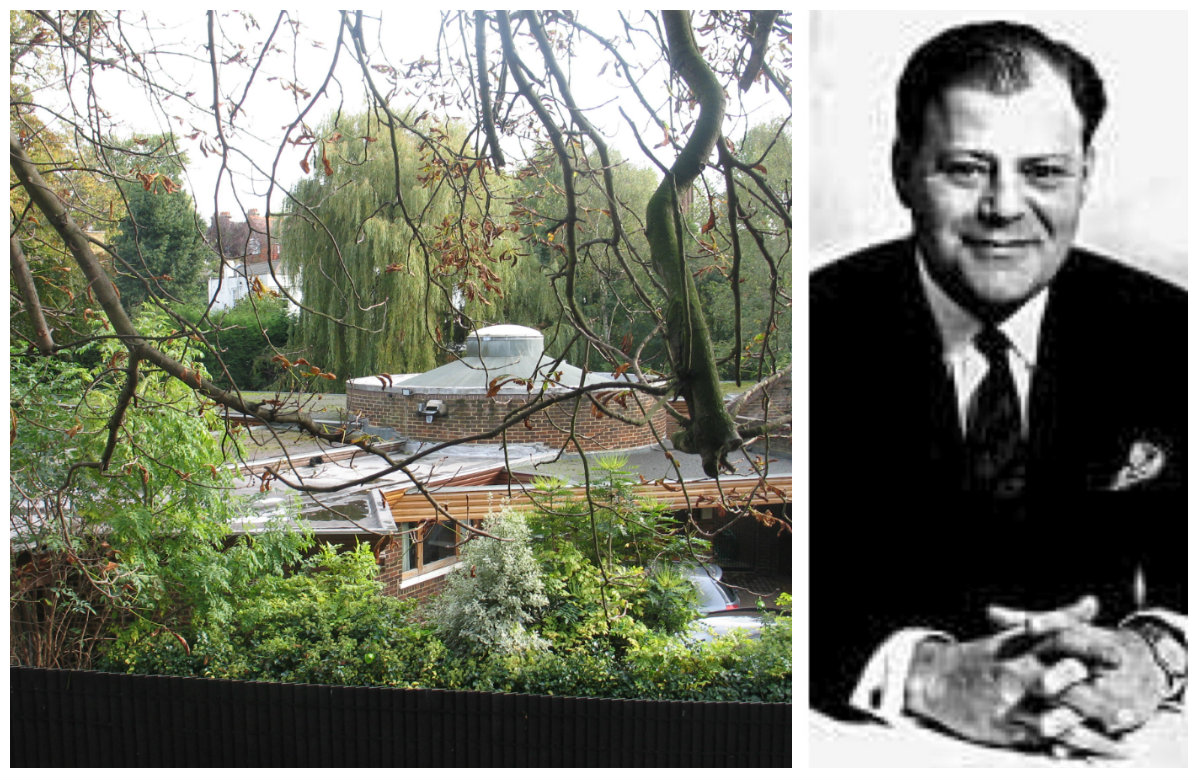
THE house that Harold Cooper built was deliberately a bungalow, removing all hurdles for his disabled wife Daphne.
By all accounts, the man, whose name may be stitched into the jeans you are wearing today, devoted his energies to making sure she would enjoy life to the full, despite being confined to a wheelchair.
And so No 22 Frognal Way was built in the late 1970s, with its drum hall reception and three single-storey wings stretching into the garden, a striking modernist design for the times which some architecture buffs still regard as a classic. But “Cooper House”, as it is has been called, in Hampstead no longer rings with the sound of family life and dinner parties.
Daphne passed away in 2006, while Harold, the founder of the ubiquitous Lee Cooper jeans brand, died in 2008.
It stands empty now, rotting in parts, missing the generous inhabitants which had originally brought it to life. According to a host of people living nearby, the dream house has become an eyesore.
Enter the video games pioneer Jez San, awarded an OBE for his work in the computing industry. Always ahead of the curve, he developed seminal games for the Commodore 64, Amiga and Atari computers in the 1980s, and more recently made inroads into the online poker market. For dedicated gamers, his game Star Fox, or Star Wing, became a masterpiece for owners of a Super Nintendo console in the 1990s. He bought the site last year and suggests the way forward is to bulldoze the Coopers’ old home, allowing him to tidy up the site with a new seven-bedroom home for his family.
His architects insist it will all be done with care and respect, and have submitted their design to Camden Council’s planners for approval.
Yet, as hospitable as he has been – Mr San held an open day to discuss the plans – not everybody remains convinced.
The raft of paperwork connected with the property, and its possible demolition, was published by the Town Hall this week; a bundle of letters and emailed messages which reveal how neighbours are split on the pros and cons of the project.
It is distinctly unusual for so many people to write in favour of a planning application, with Town Hall officers more used to wading through objections when proposals are controversial. The trend is usually for people to be quick to object, but slow to offer backing.
“I wish to show my support,” wrote one of the supporters living locally, “the house that stands on the site is not a pretty house – someone commented it could be a gas works and doesn’t look like a home.”
Another neighbour wrote: “This property does need to be renewed. I have often wondered how the house that stands has been allowed to remain there.”
We could publish many more comments in the same vein, but Mr San’s team will no doubt be most happiest with the support of the Frognal Way Association as a whole.
Its honorary secretary, Douglas Maxwell, said the group felt objectors were “mistaken” about the need to retain the house, adding that the scheme “will allow the derelict site and buildings to be revived”, and with an “unobtrusive design”.
But there are objectors here too, a street away. When demolition plans were discussed by a previous owner two years ago, the nearby Church Row Association commissioned an architecture expert to detail its importance. The house “has very considerable aesthetic value”, said the report that from came back from Neil Burton, a director of The Architectural History Practice. A planning inspector also suggested there was some merit to the existing house.
For those who admire the property, or “bungaloid” as one commentator calls it, a key factor is that it was built by Kentish Town architect Philip Pank, said to be influenced by Frank Lloyd Wright and Le Corbusier. The way he designed something that would be so suited to Daphne’s life has been a point of celebration, and the lack of other surviving examples of Pank’s work has led to an extra push for this one to be spared a date with a wrecking ball.
This time around, the Church Row Association is again opposed. Their representative Michael Patchett-Jones said in his objection that existing concerns about the need for demolition and the size of the proposed replacement had “not been allayed” by Mr San’s fresh application.
Meanwhile, David Milne, from the Church Row and Perrins Walk Neighbourhood Forum, wrote that architects could still be “capable of sensitive restoration” of Pank’s building, adding that his group thought some of the demolition was “inappropriate”.
The documents show that the Forum has suggested to Mr San that some of his supporters had other issues in mind: “We are aware that the priority of several Frognal Way residents is to resurface the road in Frognal Way and that they simply wish to see a development completed that enables this resurfacing to be commenced.”
Yet if you swing back to the collection of letters in support of Mr San’s overhaul, one of the supporters of the work going ahead, Richard Jankel, has told the council: “I feel that a considerable amount of dissent emanates from certain residents of Church Row which has little basis in fact. There is some history between the residents’ associations of Church Row and Frognal Way, where we ultimately had divergent views with regard to the Neighbourhood Forum scheme. This certainly gave rise to some of the antipathy that exists.”
It is the council’s planning department that will now have to referee the debate, with the final decision almost certain to be transferred to a panel of councillors.
Mr San’s architects said in their application their plans will not harm the conservation area.
'No doubt Coopers would have strongly approved of plans'
HAROLD Cooper, the man who turned his father’s factory into an iconic brand of jeans, would have been happy to see his former home demolished with the passing of time, according to friends.
The files published by Camden Council show how those who remember his time in Frognal Way think he would understand why an overhaul was now necessary.
Dr Christopher Williams, who lives nearby, told planners: “The Coopers were loved and vigorous members of the road and community, but highly realistic. I have no doubt that they would strongly approve of a similarly successful entrepreneur providing a new home for a family with very different long-term requirements. They would also be surprised and impressed at the care being taken to ‘do the right thing’ from visual and environmental points of view.”
Mr Cooper’s company, originally based in east London, boomed after a rebranding in the 1950s: Lee Cooper was an amalgamation with Daphne Cooper’s maiden name, Leigh. It turned denim, popular for its durability during the war, into a fashion must-have. Mr Cooper’s obituary writers said he had eventually withdrawn from the company to focus on caring for his wife, who was unable to walk after contracting a brain disease while on a trip to India in 1965. Together they founded a charitable trust aimed at funding medical research to help the disabled. He was 90 when he died seven years ago.
Another Hampstead resident, Michael Hockley, wrote to the council, explaining: “My daughter is married to the Coopers’ grandson and the whole family are interested in the proposed new building for a young growing family. I think that it is about time that another family has use of this wonderful site.”
Peter Cook's widow Lin says there is 'no sensible reason' for bulldozing Cooper House
DOCUMENTS published this week by the Town Hall show comedian Peter Cook’s widow, Lin, is among the opponents to Jez San’s plans for Frognal Way.
“In my opinion the current building makes a positive contribution to my local area,” she wrote in her objection. “No sensible reasons for its demolition have been given.”
Mrs Cook described the proposals for the new home as “massive” and questioned how the site had fallen into such disrepair in recent years. She has lived in Hampstead since the early 1980s.
'I was Pevsner's driver – he'd have been opposed'
ARCHITECTURE critic Sir Nikolaus Pevsner’s driver says the writer would have hated the idea of No 22 Frognal Way being demolished.
Pevsner died in 1983 but is still revered for his unrivalled directory of notable properties.
“Cooper House” is one of the homes mentioned in the 46-volume work.
By coincidence, Neil Stratford, one of the men who drove Pevsner around, lives nearby. He opposes the demolition plan, describing Philip Pank’s building as a “mini-Pantheon”.
In the files released by Camden Council, Mr Stratford said: “I myself acted as Pevsner’s driver in four of the counties of England, spending many weeks in his company, and I can vouch for the fact that he admired the Pank house and would have strongly opposed the present application to demolish, had he still been with us.”
Mr Stratford added that the council should put a “maintenance order” on the building.
Mr Pank, who had a practice in Kentish Town, died in 1991. He was described as “an architect of some local importance” by a planning inspector in 2008.
