Dickensian school site lined up to be converted offices for writers’ charity
Marketing process could not find any educational use for site, say planning papers
Friday, 7th August — By Amy Reid
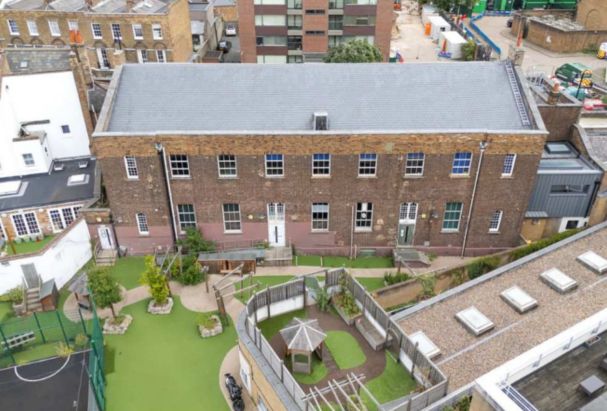
The building in Amwell Street, Clerkenwell
A 300-year-old former school in Clerkenwell where Charles Dickens once held penny readings may be turned into a literary charity’s headquarters.
The grounds in Amwell Street were home to Clerkenwell Parochial Church of England School until it closed in 2021 following falling enrolment numbers. It had been operating at around half its 240-pupil capacity when it shuttered.
Now, a planning application shows The Royal Literary Fund (RLF) – a charity which supports writers through grants and fellowships – wants to turn the Grade II listed building into its new home, with offices as well as rooms for training and events such as book launches.
An ancient fig tree in the building’s grounds, thought to be up to 200 years old and one of the oldest in the country, is not expected to be disturbed by the renovations.
Islington Council planning policy prioritises retaining social and community infrastructure such as schools, but an assessment found that there is not enough demand for the building to relaunch as a school.
The site was marketed to educational and community service providers for over 12 months to no avail.
It has not been empty since the school closed, however.
The Amwell Street site was leased by Hive Education Trust, which runs St Mary Magdalene Academy in Liverpool Road, for three years.
Now the building is occupied by around 16 live-in property guardians.
One of them – who did not wish to use their name – told the Tribune that although the Royal Literary Fund is a better option than some potential corporate alternatives, an office of commuting staff will not provide a boost to the area.
“More offices is not what Clerkenwell or South Islington needs,” they said.
“There are already so many empty office spaces around Farringdon. We have a surplus of office space and a deficit of housing across Islington. If it really can’t be a school then it should still stay in service to the community.”
The lettings agency handling the property, Alex Martin, said last autumn that it was looking for a “school, faith group or organisation that shares our vision” to occupy the site.
But this week, the agency told the Tribune: “We have marketed the space for a considerable time period and haven’t been able to find a replacement education use.
“However, we are confident that RLF’s occupation, should the planning applications be successful, will have a positive impact on the local area, continue an element of education use and have good synergies with existing uses including the Quentin Blake Illustration Centre.”
The Quentin Blake centre has recently been completed nearby.
Clerkenwell Parochial School’s falling rolls followed a 2016 Ofsted inspection which rated the school “inadequate”.
It was subsequently converted into an academy and run by the London Diocesan Board for Schools.
Since its closure, several more state primary schools have shut down in Islington, which has one of the lowest birth rates of all boroughs in the country, according to recent reports.
St Jude and St Paul’s Church of England primary, which closed last year, has since been sold off to private school The Children’s House.
Highbury Quadrant also closed last year, while New North Academy had its final day at the end of the summer term.
Islington National Education Union (NEU) joint secretary Terry Sullivan previously warned that the trend of turning council-run community schools into academies – as well as declining numbers of children in the borough – are contributing to the school closures.
Mildmay councillor Carlos Valero, who is also the Islington Greens’ spokesperson for children’s issues, said: “The unfortunate reality is that schools will continue to close as fewer families can afford to raise children in Islington.
“But this isn’t inevitable: it is the consequence of decades of poor political choices, from unaffordable housing and inadequate childcare to immense Ofsted pressures.
“Schools and their buildings are also vital community assets, and where possible, we must fight to protect them.”
When news of the school’s closure was announced in 2020, then-headteacher Amanda Szewczyk-Radley said: “Sadly, there do not seem to be enough children in our area to keep our wonderful school viable.”
Islington Council and the RLF both declined to comment due to it being an active planning application.
