Firebomb spies search planning files for weak points, City Hall was warned
Attack on PM’s north London property is ‘linked to Russia’
Friday, 19th June — By Richard Osley
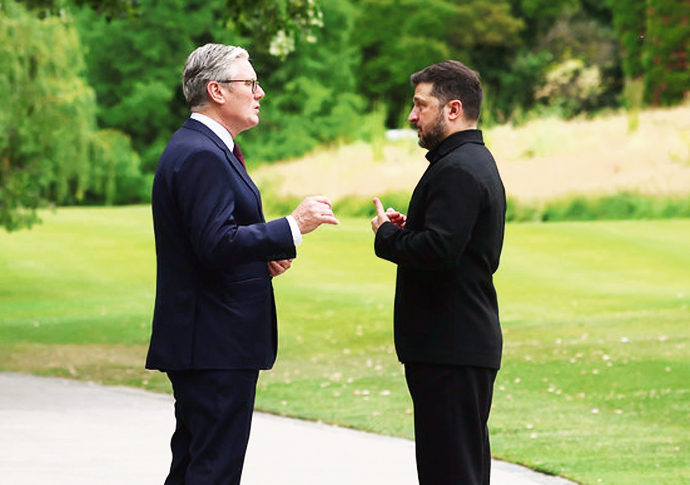
Sir Keir Starmer meets Ukrainian leader Volodymyr Zelenskyy in France this week [Simon Dawson/ Downing Street]
HOSTILE forces are scouring planning documents and building control records for weak points and possible arson targets.
The warning was delivered at a hardly watched committee meeting at the London Assembly, soon after a car and property in north London linked to Sir Keir Starmer were hit in fire attacks.
Two Ukrainian men working under the orders of a mystery Russian-speaking handler, known on the Telegram messaging service only as “El Money”, are due to be sentenced tomorrow in connection with the vandalism, and there have been claims linking the incidents back to Russia.
When Stephen MacKenzie, an independent fire and security consultant, was asked to give expert evidence to City Hall last year, he had said: “We have got war in Europe, now we have got Russian proxies operating in the UK.
“The biggest case was a Novichok attack, but we have seen it sweep across Europe from state actors, from Russia setting fire to civilian shopping malls, doing online searches. Whether it is the Main Intelligence Directorate (GRU) or the Federal Security Service of the Russian Federation, the intelligence services for Russia are looking at planning permissions, building control applications for fire and life safety system vulnerabilities.
“That is the most concerning thing I have seen in three decades I have been in this sector.”
Documents freely available to view on local authority websites can contain details about building layouts, fire-protection measures, access routes, evacuation arrangements and construction programmes. Making them public enables residents and conservation groups to comment on applications with the full proposals in front of them.
The use of arson as a form of terror has been seen across the country, with reports of Ukrainian-owned businesses being targeted in what initially seemed unexplained fires.
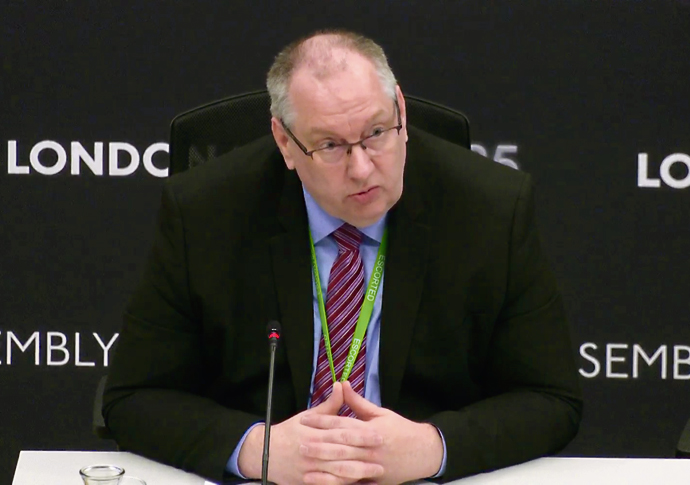
Independent adviser Stephen Mackenzie at City Hall
Mr MacKenzie said: “Certain countries are being slammed around the world. It does not even need a state actor; social unrest could be a mechanism if we have seen what has happened in France of late following football matches. Arson is the straight go-to for social unrest.
“We are very sophisticated in London with our counterterrorism response because of the Northern Ireland Troubles and we need to revive that.
“The Cold War has not gone away; it has just evolved to become more dangerous and now we are seeing drones, independent vehicles, an evolution of incendiary devices which is terrifying, and a lot of technology coming out of the Ukraine conflict that we should all be looking at and be aware of.”
The two men are now facing prison sentences after fires last May at Mr Starmer’s constituency property in Kentish Town, a car he once owned and a flat in Islington where he had previously lived.
Roman Lavrynovych, 22, and Romanian Stanislav Carpiuc, 27, were convicted of plotting to damage property.
Prosecutors said Lavrynovych and Carpiuc carried out the attacks on behalf of “El Money” in return for payments worth approximately £3,000 in cryptocurrency.
Jurors heard evidence that the Telegram contact took steps to conceal his identity and maintain operational security.
In one message, he instructed Lavrynovych to leave the country, while another added: “If the police detain you, secretly write the word, ‘geranium’, and I’ll send a lawyer to you.”
The BBC claimed this week that El Money’s true identity is that of a Russian diplomat.
Following the verdicts, Commander Helen Flanagan, head of Counter Terrorism Policing London, said the aim of the attacks had been clear.
“The intention from the online tasker was to create fear, both for the victim and the prime minister, and cause uncertainty and unrest in the UK,” she said.
Mr Starmer, speaking while attending the G7 summit in Evian, France, said: “Obviously it was a bad attack, and all the details have now come out in court and justice has been done.”
Charlie Pugsley, then the deputy commissioner of the London Fire Brigade, had told the City Hall meeting that special focus had been on the use of fire as a weapon for some time.
“We cannot be complacent because it is the old thing about somebody only needs to be successful once. Therefore we are definitely not complacent,” he said.
