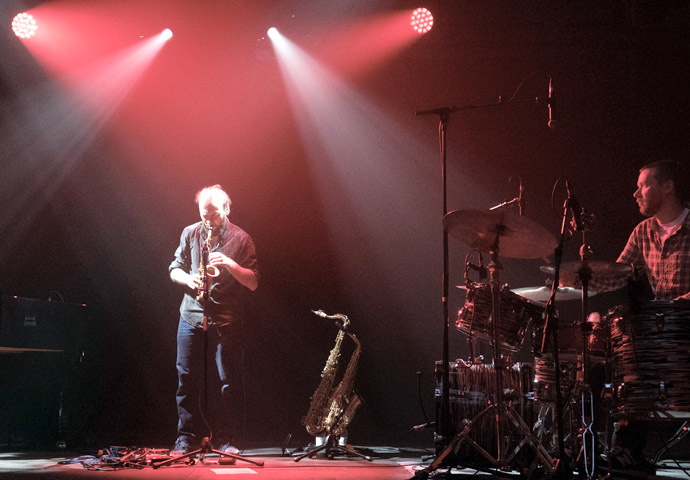
Mammal Hands [Ilya Tishchenko]
ONE of the most extraordinary stories in jazz and global music is the discovery of Emahoy, aka The Honky Tonk Nun (as a Radio 4 documentary had it) a classically trained Ethiopian who, having taken the veil, lived on a remote mountaintop yet somehow managed to create a unique and compellingly beautiful blend of classical, blues and sacred tunes.
She first came to the wider world’s attention on a remarkable album called Éthiopiques, Vol 21: Piano Solo. Its not exactly jazz or classical but seems to exist in its own space, the tethers to conventional meter and harmony severed by her self-impose exile.
I mention this because at the Barbican on April 29 The Vernon Spring (Sam Beste to his friends and family) opened with Emahoy’s composition Mother’s Love, playing it on an upright piano which looked as if it had been redesigned by the BBC Radiophonic Workshop.
And it was quite mesmerising, the melody and syncopation in the original slowed as if it was being reined in and given room to breathe. In fact, it was this sense of restraint, giving each note its own personal space, that characterised the entire piano-with-electronics set. The shifting layers of sound, gently teased apart, really did keep the audience enraptured – it felt rude to even breathe too loudly.
Beste – a north Londoner who used to be Amy Winehouse’s live piano player – finished with Donny Hathaway’s For All We Know (which Amy would have known and loved), somehow stripped of all its soul yet left with bags of emotion.
If you like Max Richter, Nils Frahm or Hania Rani, check out The Vernon Spring’s latest album Under A Familiar Sun, which deploys a somewhat more expansive palette than Beste used at the Barbican, but which is no less involving.
The main act was Mammal Hands, a band from Norwich that emerged around the same time at Manchester’s GoGo Penguin and occupying the same sonic sphere of Steve Reich meets Esbjörn Svensson. Both were signed to trumpeter Matthew Halsall’s Gondwana label and I saw each live bands early on and thought GoGo Penguin had the edge in energy, hooks and dynamics. But, of course, nothing stands still in the world of jazz.
Mammal Hands are now signed to the ACT label (home to Esbjörn Svensson and Emma Rawicz). Futhermore, they have a new drummer joining Nick Smart (piano and electronics) and Jordan Smart (saxes and electronics) – Rob Turner, who used to play with Go Go Penguin. I interviewed him several times when he was with the latter and I enjoyed his approach to percussion and marvelled how he could play with machine-tooled precision. He seems to have loosened up (humanised?) a little with Mammal Hands, but as with Penguin, he provides a compelling propulsive force, with beats drawn from drum’n’bass as much as jazz.
The band opened with selections from the new album Circadia but dipped into the back catalogue of hypnotic vamps and themes with the likes of the soaring Black Sails from 2017’s Shadow Work. If the sonic landscape was familiar, it had a fresh urgency – it sounded like a band re-invigorated and able to cut loose a little more than I recalled (more of that please).
The sometimes austere music of both The Vernon Spring and Mammal Hands was well suited to the Barbican – at no point did I think (as I have on occasion with other groups) this would be better suited to a jazz club rather than a concert hall.
One thought: next time maybe turn Nick Smart’s piano side-on to the audience so we don’t only see the back of his plaid shirt for the whole performance.
Interestingly, I’ll be able to compare and contrast Rob Turner’s bands again when GoGo Penguin (who also have a strong new album, Necessary Fictions, which features an expanded musical range) play Camden’s KOKO on as part of the EFG London Jazz Festival on November 16 and 17. See: https://efglondonjazzfestival.org.uk/events/gogo-penguin-2
