Heat havoc as schools close doors
Parents are left scrambling to find childcare as temperatures soar
Friday, 26th June — By Isabel Loubser
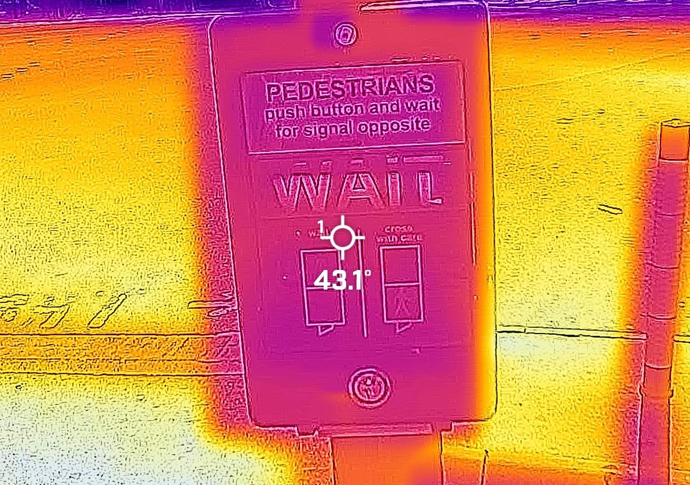
Temperatures reached blistering heights on Tuesday, with our photographer Simon Lamrock’s heat camera capturing 43 degrees at a pedestrian crossing in Angel [Simon Lamrock]
PARENTS were left scrambling to find childcare this week as schools shut their doors to deal with the extreme heat gripping London.
Primaries said pupils could be picked up in the early afternoon to avoid the highest temperatures on Wednesday and Thursday.
But working parents said this put them in a “difficult” situation – firing off last minute requests to bosses for the time off or missing out on wages altogether.
Mum of four Alicia Perez, who works as a childminder, said that the cancelled school days meant she would not be able to work.
She told the Tribune: “The schools can close, the nurseries can do reduced hours but childminders can’t unless they give the parents the money back or make up the hours at another stage.
“For me, if I have my four children at home, I can’t take care of any more children. You can’t have a cramped house full of kids, so it’s either a loss of wages or work for free.”
“The safety of the children and the staff has to be a priority, but it is pretty difficult to arrange childcare”, added parent Andri Andreou, “We are grateful that there are both of us at home, but we’re having to alter our days to cover the early finish.
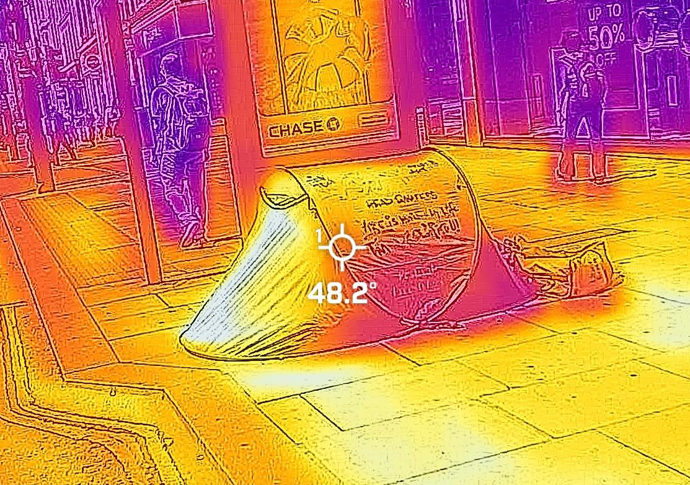
48 degrees inside tents being used by rough sleepers [Simon Lamrock]
Across the borough, trips were cancelled, children kept inside, and early pick-up times arranged as temperatures reached 36 degrees on Thursday. Some schools had paddling pools in the playground, or even a sprinkler system, but parents have warned that primaries must adapt further to cope with hotter summers.
Ms Perez said: “Global warming is coming, and the UK is not ready for this. We need to look at other countries that have figured it out before us.”
Originally from Spain, Ms Perez said the council should look to the continent, where schools close earlier for summer and children can attend cheap — or free — camps during July and August.
She added: “Extreme heat is going to be happening more and more, and the schools are going to be closing more because they don’t have air conditioning. We need to make reasonable adjustments, the council could make a plan to close the schools in the middle of June, and then run other activities outside the classroom after that.”
Schools are often encouraged to stay open in order to ensure students do not miss out on learning time, and attendance, a metric by which educational institutions are judged, does not dip.
Ms Andreou said: “If schools are constantly having to finish early, then it becomes a cost to the children’s education. We do need to equip our schools better and consider installing air conditioning. Even though it’s expensive, it’s the price you put on our children.”
As temperatures headed towards 40 degrees and the view that this may soon become a summer norm became more prevalent, there have been concerns that old school buildings are not built to withstand the heat – and neither are thousands of council flats that children go home to.

Alicia Perez
Ms Perez, who lives on the Parkview Estate, said: “We’re all just breathing each other’s heat, it’s unbearable. The flats are not built to withstand the cold — it gets damp and mouldy when you turn the heating on in winter, but they’re not built for the heat either.”
Sheila Chapman, the Town Hall’s children’s chief, said: “We’ve provided guidance to schools on how to reduce heat risks, including encouraging hydration, appropriate clothing and sun protection, adapting indoor environments, and avoiding the hottest parts of the day.
“We’ve also shared wider public health guidance and information on local cool spaces with schools.
“Where necessary, schools may modify the school day, rearranging activities, or, in exceptional cases, close early, based on local conditions and in consultation with governing bodies. Parents and carers should check with schools directly for any updates.
“While schools are expected to remain open, leaders are required to carry out thorough risk assessments to protect the health, safety, and wellbeing of children and staff.”
Frontline workers sweat it out
TUBE drivers, chefs, and firefighters are amongst the workers who will suffer the most as workplace temperatures soar, according to campaigners fighting for a maximum working temperature, writes Isabel Loubser.
In Spain and Germany, there is a maximum indoor workplace temperature of 27°C and 26°C, but in the UK, which has a maximum legal temperature for transporting livestock, there are no such laws for workplaces.
“It’s like Covid”, said Miranda Irwin, from Extinction Rebellion, “it’s the frontline workers who aren’t able to work from home or adapt their workplaces easily that are the most at risk.
“Workers working outdoors, posties, communications workers fixing cables are all exposed to extreme heat and it becomes really dangerous. There’s a risk of injury to people working on the national grid, working from heights.
“Teachers, because they are in classrooms which are not well maintained and designed for the heat, struggle to manage.”
Heat Strike is a group of trade unions and environmental organisations who are fighting for the law to change. They have called on the government to set a national maximum indoor working temperature of 30°C and 27°C for strenuous labour.
Ms Irwin, who lives near Hornsey Road, told the Tribune: “A maximum working temperature would incentivise employers to make changes in the workplace so that employees could come to work. The bottom line is that going to work shouldn’t be a risk to your health.”
Environmental campaigners have been sounding the alarm on the climate crisis for decades, yet for many, the reality of the destruction caused by climate change still feels very far away. It is only when temperatures soar in the UK that many people realise how they too will be directly impacted by global warming.
“That’s part of why we take action when it’s really hot”, said Ms Irwin.
“We do our activities when it’s really hot because that’s why people can really see and appreciate the impacts the most, and then we can have really constructive conversations with people.”
She added: “We want people to check the temperatures in their workplaces, to organise in their workplaces around the heat, and be aware of the health and safety rights around work.”
