How ‘playful and poetic’ Mendini reimagined everyday objects
Exhibition examines Milan-born architect’s distinctive postmodernist approach
Thursday, 26th March — By John Evans
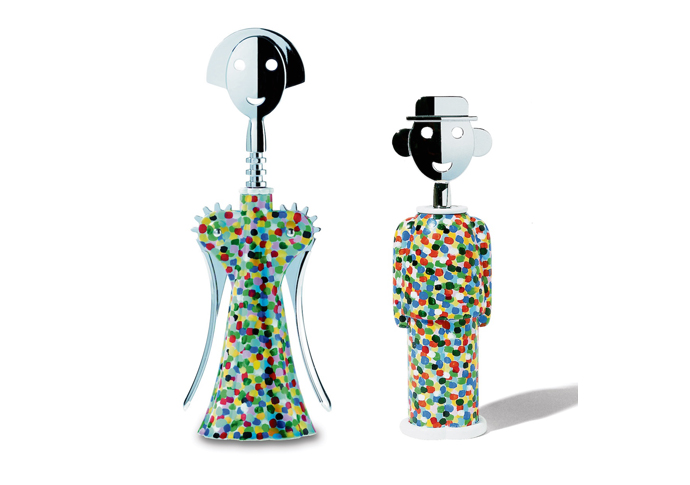
Alessandro Mendini, Anna G. and Alessandro M., 2003 ‘Proust’ corkscrew in chrome-plated zamak and thermoplastic resin with Proust decoration, Alessi, project with Annalisa Margarini. Alessi Photographic Archive
DESIGNS born out of a “playful and poetic” approach is a description given to those of Milan-born architect Alessandro Mendini, currently to be seen at the Estorick Collection in what is a first solo outing for them in the United Kingdom*.
Estorick director Roberta Cremoncini notes in a catalogue foreword: “Mendini’s own reimagining of the everyday reveals a… desire to elevate objects far above their practical function, transforming them into vessels of symbolic meaning and unexpected joy”.
These invite us to reconsider the everyday and their effect not only on environment but also our way of seeing the world, she says.
And in this Mendini drew inspiration from the “Italian Futurist movement (1909-1940)” the Estorick notes.
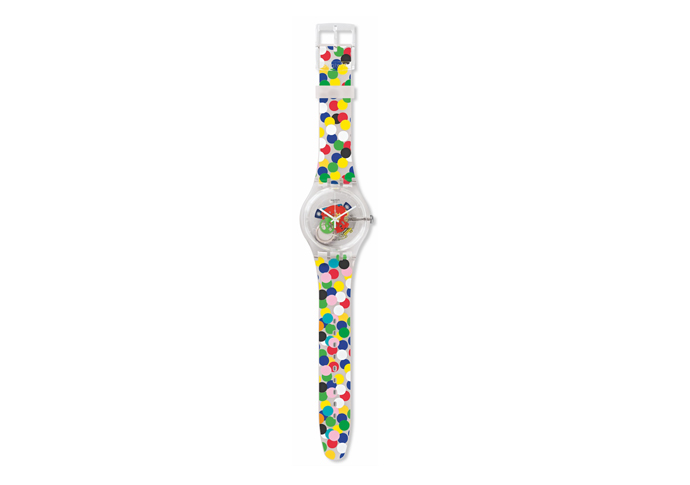
Alessandro Mendini, Spot the Dot, 2016, plastic wristwatch, Swatch, Archivio Alessandro Mendini
Indeed, in some measure, the success of Mendini (1931-2019) in elevating the objects is illustrated by the familiarity with which many will view some of them. There’s the “spot the dot” Swatch watch, the bottle openers and corkscrews for Alessi, and Mendini would also work for the likes of Cartier, Hermes, Louis Vuitton, and Philips.
He advised companies such as Samsung and LG on design and image; but also collaborated on projects including the uniquely colourful Groninger Museum in the Netherlands, an artwork in itself, the Alessi factory, and even stations for the Naples metro.
This show includes paintings, ceramics, sculptures, drawings, chairs (notably the “Proust armchair”), rugs, and more, with splashes of colour throughout.
It examines Mendini’s distinctive postmodernist approach and willingness to use it within the mass production context. It also looks at influences upon him, from artist Kazimir Malevich (1879-1935) to those Futurists, such as Marinetti, Balla, Boccioni, and Severini to whom he pays tribute in a series of “mechanical masks” in the show.
• Alessandro Mendini, at the Estorick Collection of Modern Italian Art, N1 2AN until May 10. www.estorickcollection.com
