‘I like representing the figure’
Allen Jones guides Lloyd Bickham through Taking Shape, his new exhibition for Camden Arts Projects
Thursday, 25th June — By Lloyd Bickham
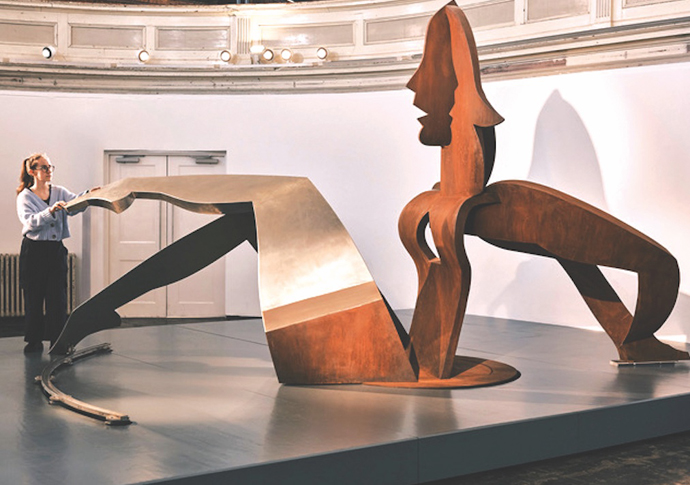
Exhibition view of Taking Shape at Camden Arts Projects [Leon Chew. Courtesy of the artist and Camden Arts Projects]
DANGLING from a single thin wire, a shimmering, five-metre-long metallic figure dominates the eyeline at Allen Jones’ new exhibition for Camden Arts Projects. There is also a towering elephant in the room – one that catapulted Jones to fame, and continues to dog him to this day.
As he guides me around the room, we inevitably broach the subject of his 1969 work, Hatstand, Table and Chair. Featuring lifesize, fetishised female figures as household objects, these sculptures drew controversy from feminist groups, and were the target of vandalism at subsequent exhibitions.
Despite resisting criticism at the time, Jones now concedes that: “If I’d been running [feminist magazine] Spare Rib and I’d seen my furniture sculptures, I’d have thought that was a perfect illustration of someone being turned into an object.
“In reality, that work was being made in reaction to the art scene,” Jones claims. “The avant-garde was minimalism and abstraction. But I like representing the figure, and didn’t like the idea that you could no longer do it because now people were painting squares.”
For Jones, Hatstand was a way of satisfying both. “I rang up Madame Tussauds and ordered the figures through them – I wanted the sculptures to avoid my self-expression.”
They may not be on display here – it’s clear that Jones wants to show a different side to his work today – but sculpture dominates his current Camden residency. Below the sprawling, suspended Aeriel figure, Large Swivel is another vast form, the oxidised coating of its body inspired by old gunning emplacements he’d explored on childhood holidays to Swansea.
These relics of war featured tracks in the ground, utilised here to allow viewers to move the legs of the figure; Jones “like[s] to encourage that sort of tactile sensation or response, engaging you physically with work”.
He pushes a calf to demonstrate the manoeuvrability of the piece; the lower limbs of the sculpture are clad in silver, metallic stockings.
Last month, it was Kim Kardashian clad in evocative “Body Armour” of Jones’s creation, appearing at New York’s Met Gala in a tight fibreglass orange breastplate. As images of the colossal celebrity event were beamed worldwide, the collaboration introduced Jones to a new generation, stirring fresh controversy and admiration for his work with the female form.
As we continue our tour, Jones is eager that his polarising legacy is written as an intellectual feat. He talks me through the challenges of crafting warping structures using a single sheet of metal, to his recent fascination with shadows.
“I suddenly realised that all of my outdoor sculptures were casting forms which will never be fully replicated until the sun aligns again in a year,” he says, gesturing to Red and Blue Queen.
They are colourful Pop monoliths topped with perspex, their shadows casting the image of Medusas with decidedly pointy breasts.
“It was nothing to do with sex, you know,” Jones tells me, of his dismissal from the Royal College of Art in his first year. “Our cohort was unusual, there was David Hockney, Derek Boshier and myself.”
A group now regarded as the legendary vanguard of the British Pop Art movement, at the time, were at war with the establishment. “We were being taught by people who were still in the 19th century,” Jones explains. “I’d imagined that debate was what it was all about, but that wasn’t the case.
“We’d have life drawing classes, and I’d use colour to describe space rather than directly illustrating matter. My teacher, Ruskin Spear, would say: ‘What’s going on here? This is a grey day, she’s a grey woman with grey prospects, what’s all this ****ing colour? You’re a bloody decorator!’”.
Colour is employed liberally in Belle of Shoreditch, a new three-dimensional painted work depicting a dancer in a local strip club. Behind her, as her legs cast across protruding wooden panels, are glimpses of everyday life outside.
It’s a real scene – a venue near Jones’s studio that he “stumbled across. Inside, you had two doors out onto the road and in between them was the stripper, doing her stuff […] taking her clothes off and wheeling them out. And on each side of her, you could see the pavement, mums and dads walking along, someone’s pushing the baby.
“Did they know that six feet away from them, this teenager is stripping off?”
At 88, Jones shows no sign of slowing down, nor shying from divisive eroticism. Alongside Hockney in 1961’s Young Contemporaries exhibition, he helped forge new frontiers for Pop Art this side of the Atlantic. Today in Camden, he’s still kicking, treading that thin line between avant-garde and objectification.
• Allen Jones: Taking Shape, until August 30 at Camden Arts Projects, 176 Prince of Wales Road, NW5 3PT. Open 11am-6pm, Wednesday-Sunday. See https://camdenartsprojects.com/
