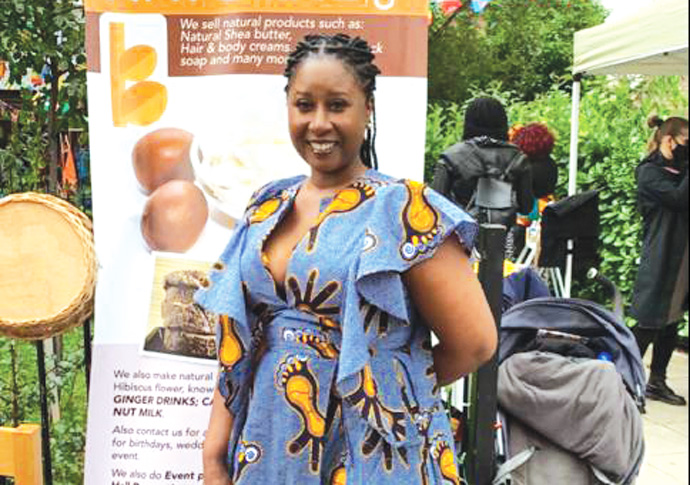
A passion for fashion – Anna Njie
AS a young person growing up in London I used to be bullied a lot because of my African heritage. And I never denied it, I was always very, very proud to be of African heritage as a child.
My parents took me to Gambia when I was about seven and what I found coming from a high-rise block of flats on the 13th floor and not being allowed out, to go to Gambia – where I’m originally from – having the freedom of playing out, safety, community, family, eating together in one place… It was a whole different ballgame.
In Gambia you were taught by the elders, about their journey in life, how to appreciate life, people and culture, how to give to the poor. I grew up with that, going back and forth to Gambia.
And then at 17 when I stopped visiting, I found myself at sea, following a Western culture that wasn’t mine, finding myself uncomfortable and lost.
I had to reconnect with my African heritage to get back on track. And when I started Fashion 4 Africa, I realised there was a lot of young people that felt like that. Some had never even been to Africa before.
Even though it was called Fashion 4 Africa, I embrace Caribbeans and people who are biracial, Asians, even white South Africans, because they are displaced as much as we are. We’re British, but we’re displaced here.
It’s important that young people know where they’ve come from and understand that belonging. It helps you to develop as a person. It can be like being lost at sea, you have no sense of direction or where you’re supposed to go. But if you understand your heritage, you understand your culture, then you understand your purpose.
Fashion 4 Africa has two goals. The models we train for self-confidence and body confidence and give them catwalk training, that’s for young people.
And then there are also the designers, but that doesn’t have an age limit.
I found that mostly older women had started in fashion – some people were seamstresses even before they came to the UK – then stopped. Sometimes they’ve got children and life takes over.
Women think they’ve got to get a stable job and they can’t continue their passion. Fashion 4 Africa was a way of bringing back those skills.
Now that’s on pause because of the pandemic. But I think Covid brought out that people should care about each other. The Covid situation was our time to shine.
It’s been a long-term ambition to start the Go Africa Festival and funnily enough, Covid was the perfectly imperfect platform for that to shine. I was able to plan and programme a series of workshops and activities. The workshops were a subtle method of supporting the community out of isolation, depression and boredom.
When I moved to Islington in 1995, everybody was segregated, there was nothing. I found it hard to find people like myself, I didn’t know where to go. There was nothing in the libraries.
The reason I’ve been really adamant about sticking in Islington is because we have a lot of different cultures. The Go Africa Festival has shown that it is possible to bring these people together.
I feel like the Go Africa Festival created something that people need. People were dancing in Upper Street. I believe in what I’m doing, that simple activities can heal people. They may seem simplistic, but they are effective.
I’m passionate about people’s well-being and mental health. Sometimes people can’t cope with the Western world or the fast lane and tech and everything that’s going on.
And I’ve known people who have had mental health issues, and taking them back home to that space where you’re cared for, nurtured and have peace, I found that experience has brought them back to themselves.
