‘It was a young, exciting, emerging technology – it felt like it could go anywhere’
Lloyd Bickham talks to film historian Alex Kirstukas ahead of his event on how ‘Early Cinema’ affected the West End stage
Thursday, 10th September — By Lloyd Bickham
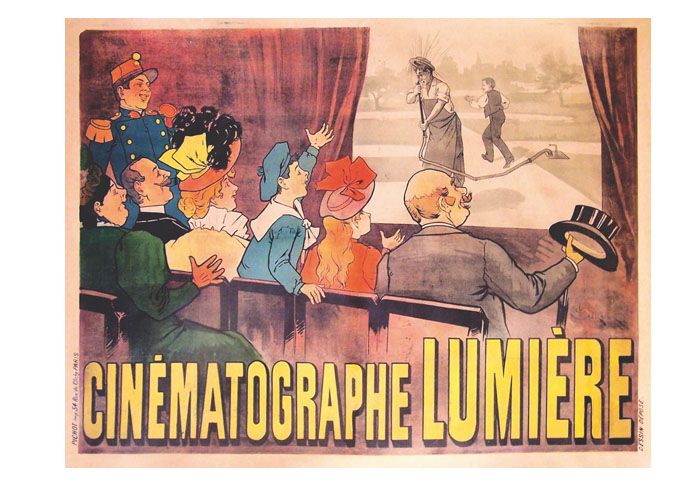
1896 poster by Marcellin Auzolle advertising early film showings by the Lumière brothers
ONE hundred and twenty-two years before then health secretary Matt Hancock was caught on CCTV kissing an aide, Theatre Royal Drury Lane was playing out an eerily similar scene.
In Hearts are Trumps, a politician’s mistress decides to blackmail her lover in a delightfully modern way – arranging for a friend to film the affair. She then beams the footage in front of a bustling music hall, leaving his fictional career in tatters.
It was “a very meta piece of writing – you had the real audience watching the fake audience see this film on stage,” according to Alex Kirstukas.
“You could say the play was an early melodrama about Cancel Culture, really.”
Alex has been poring through documents at the London Archives in Clerkenwell, finding tantalising examples of how film reel was embraced by the West End theatre scene long before cinema had become a concept.
His research paints a pioneering picture of “Gothic late-Victorian London, that of Jack the Ripper and constant technological advancement. In December 1895, across the channel in Paris, the Lumière Brothers projected public films, and it became a craze”
These early, short projections quickly found their way to the UK, with a population “obsessed with new ‘things’, wanting an encyclopedic vision of the real world,” says Alex.
As such, these early film reels were largely practical – documenting trains pulling into stations, or waves crashing into the shore. In fact, 1896’s 39-second Rough Sea at Dover became one of Britain’s most popular and widely screened early films.
“That Christmas, many of the West End theatres were showing Rough Sea as a big, flashy spectacle at the end of their pantomimes. It didn’t need to tie into the plot, it was enough of an experience for audiences.”
But it was soon clear that film could provide more than novel spectacle. Theatre creatives were asking: “How can we use this as a special effect to enhance our work?”
I wondered whether there was any backlash to this new technology; was there a fear, as with AI, that film could push human artistry to the fringes?
“At the start, no,” says Alex. “It was actually seen as something which could create more jobs, because there was no direct competition with the stage. These films were black and white, short and had no sound. They could be used as practical effects.”
The bigger fear was literal – film could cause fire. It was made from cellulose nitrate, one of the most flammable materials in existence. The London County Council feared the West End burning down, and even suggested having two firemen present at every projector. In the end, theatres settled on lots of asbestos.
In 1900, however, film was becoming more sophisticated. George Méliès, inspired by the magic shows he saw in London, applied similar techniques to filmmaking.
“That year, the London Hippodrome’s inaugural pantomime was Cinderella. Méliès’ film of the fairytale was just out. The Hippodrome decided to have Cinderella fall asleep in the first act… Then, a screen appears and projects his film as a dream sequence, before the exact same story plays out on stage.”
But film was becoming a medium in its own right, with longer run times and greater artistic expression.
The Royal Opera House even helped develop what we’d call “event cinema”, screening the play The Miracle in 1912.
“They built a massive castle on the stage, its large doors opening to reveal the screen” Alex tells me.
“There was a boom in cinema building, and theatres, down on their luck, were very happy to be converted.”
By 1913, the so-called Cinema Craze was in full swing. “Musicals such as The Cinema Star at The Shaftesbury started reacting to cinema, with plots about censorship,” says Alex. “There’s dialogue between older stage actors, who are now having to work in film… They’re moaning: ‘bring back the good old theatre days, we don’t like this’.”
But for Alex, there’s magic in those early film experiments.
“I was studying at The Royal Central School of Speech and Drama in Swiss Cottage, and found these silent reels of early stage performers, still living on screen as glimmering light. It was beautiful.”
That experimentation hasn’t gone anywhere. “If you go to a West End show, there’s so much projection – lots of VR and augmented reality is cropping up. This all links back to these early film innovations.
“That period is often coined ‘Early Film’, but I prefer ‘Young Film’, because that’s what it was. It was a young, exciting, emerging technology – it felt like it could go anywhere.
“London theatre always responds to stuff like that.”
• Alex Kirstukas is a researcher in drama and music at Royal Holloway University. His talk, The Screen’s A Stage: Showmanship and Early Film in the West End, comes up at The London Archives, 40 Northampton Road, EC1R 0HB on September 14, noon-1.30pm. Tickets, £5
