It’s Mary and the DNA of history
Free exhibition aims to show a potential link between archaeology and future advances
Friday, 28th August — By Felix Bright
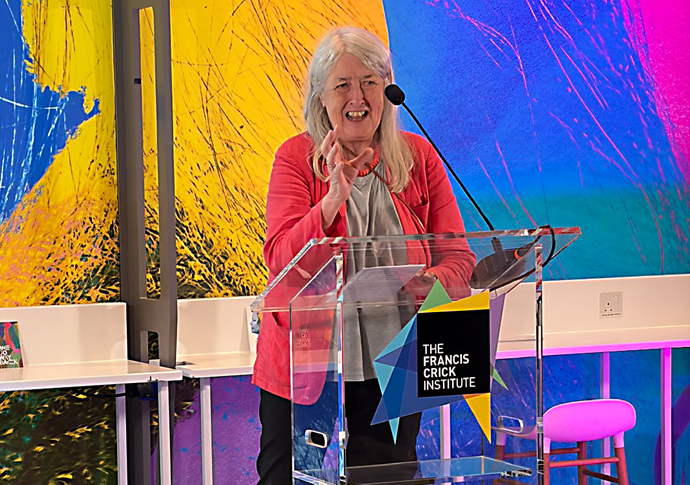
Professor Dame Mary Beard at the Francis Crick Institute
CLASSICIST Mary Beard said new scientific discoveries could be the key to discovering ancient historical secrets once lost to time, while helping to launch a new exhibition in King’s Cross.
The Francis Crick Institute’s new exhibition, We Go Way Back, celebrates groundbreaking DNA research that hopes to open new avenues of discovery in a wide range of disciplines.
Archaeology and the curing of rare diseases are just two of the fields of study that the Institute believes will be transformed by its genomic discoveries. The free exhibition is open to the public and is being held in the Manby Gallery on the Institute’s ground floor until July 2027.
Professor Dame Mary Beard – a specialist in Ancient Rome and a trustee at the British Museum – said: “Ancient DNA does make historians think again about quite a lot of the stuff that they took for granted.”
“Ancient DNA analysis gives a voice to people otherwise lost to us. There is a tendency, when we look back to people in the distant past, to project our own preconceptions and assumptions about almost everything.”
Dame Mary spoke about her association with the project. She said: “I think my brand is much more about wondering about the ordinary people of the past –and this project lets me do that from the deep past. In some ways that makes it terribly appropriate that I became involved with this. One of the developments in the last few years of my career has been the new ways ancient DNA can be used to get close to the people I’m interested in.”
Dame Mary drew on examples of how DNA analysis has already been used to correct a historical misconception.
She said: “I’m always very struck when I’ve visited Pompeii: one of the things this study of ancient DNA has allowed us to see is that sometimes those little romantically inclined family groups we imagined were not related to one another at all.
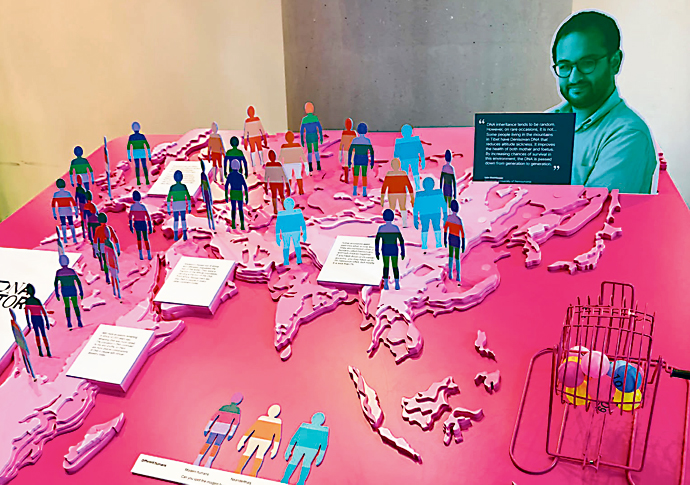
A historical DNA map of the world
“They were just victims who were thrown together in the middle of a volcanic eruption, not a plucky family trying to get away.”
She also explained how the genealogical advances made by institutions at the Crick have begun to flip agreed-upon gender stereotypes on their head.
“50 years ago they’d look at what the skeleton was buried with [to determine its gender]. If the skeleton was buried with a sword, well, that meant it was a boy; if the skeleton was buried with a comb, immediately, it was female.
“Even back then I thought, ‘didn’t men comb their hair in the Middle Ages?’” she said. “A brilliant example of how some ancient DNA analysis has really unseated one of those particular preconceptions is the Upton Lovell Shaman.”
The Upton Lovell Shaman is an almost 4,000-year-old skeleton dug up in Wiltshire 200 years ago.
Dame Mary said: “The skeleton had always been gendered male because he was tall and important. It turns out to be quite the reverse. I don’t think that ancient DNA is the magic bullet for solving all the problems of antiquity. It does become a magic bullet in collaboration with other aspects of historical inquiry.”
Pontus Skoglund, team leader of the Crick-based researchers, also spoke at the event. He explained how his team’s research on evolution can help modern medicine. We believe an evolutionary perspective could hold the keys to modern health,” Mr Skoglund said.
“Not only in increasing our pandemic preparedness, but also in understanding the role of the immune system”
He stated that his team’s research can be used to assess the risks surrounding non-communicable diseases, including auto-immunity, metabolic disease, cancer, neuro-degeneration and psychiatric conditions.
Mr Skoglund, who has worked at the Institute since 2017, acknowledged history’s important role in defining ancestry and hopes his work can help further the study of non-medical fields, too.
“History shaped our ancestry rather than our ancestry shaping history, and there are many examples of this throughout the exhibition,” he said. “Ancestry is not a single monolithic thing. There is no starting point for history. Ancestry finds itself in different places at different points in time – this wonder of ancestry gives us a sense of vertigo. It’s something we hope you take away from this exhibition.”
