Kind, gentle Bob was a key figure in the folk movement
Much-loved performer used his voice to sing about life through a political lens
Friday, 23rd October — By Dan Carrier
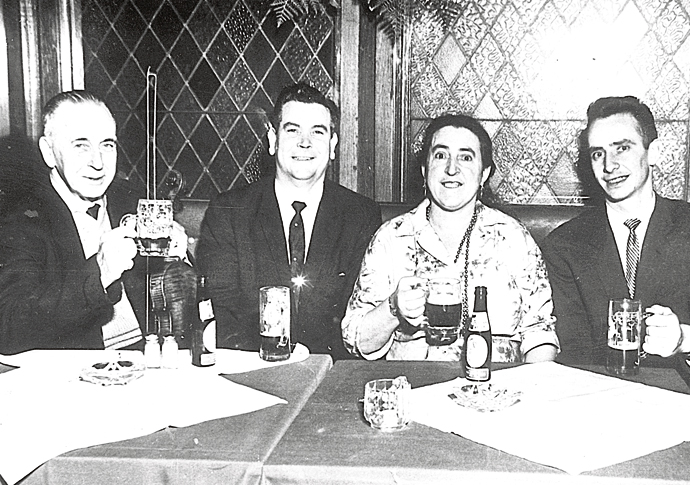
Bob Davenport with Irish singer Margaret Barry
BOB Davenport was one of the kindest and gentlest men you could wish to meet: and when he began to sing, his character poured out through his sweet, sweet vocals.
Bob, who has died aged 94, was both a regular correspondent to the Tribune and a much-loved friend to colleagues at the paper. He sang for us at our weddings and our birthdays, and was always on hand to offer help, encouragement and sage, gentle advice.
Bob was born in Gateshead in May 1932 and his early days were marked by a tragedy that saw a gas explosion kill his father, Thomas, who was just 23, and his grandfather. The blast destroyed his family home.
During the war, Bob was evacuated to a farm in Yorkshire, but he was homesick and his mother Sarah missed him – so she brought him back home, where he lived with his three half-siblings.
His early life saw Bob exposed to a huge range of musical influences: from Geordie folk songs such as The Herrin’s Head, Wor Nanny’s a Mazer and Bonny Boy a Growing, which he heard at miners’ clubs and welfare dances, to listening to American records brought to Newcastle by sailors.
He was a regular at the Newcastle Odeon where he soaked up trad and modern jazz. He would also recall radio programmes such as Jack Armstrong’s Northumbrian Barn Dance and Radio Athlone’s Ceilidh Hour.
His mother would turn the volume up so an Irish family who lived upstairs could enjoy the shows, too. These early musical experiences would live with him for the rest of his life.
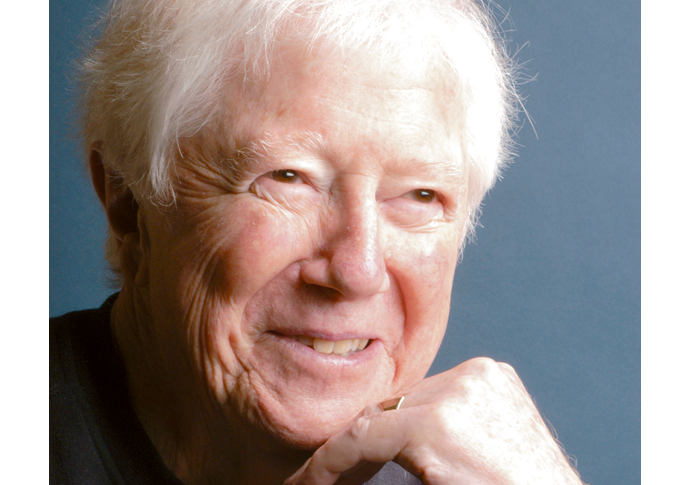
Bob in a more recent picture
Bob was an RAF national serviceman and spent evenings in London jazz clubs whenever he could. After being demobbed Bob was diagnosed with TB and pleurisy. He spent months at the Royal Brompton hospital and then a convalescent home, hoping his voice would recover.
He settled in London, working for the Post Office during the day while studying art at St Martin’s at night, his tutor being Sir Hugh Casson.
He made sculptures, models out of balsa wood, painted and drew. It was during this time he helped make ends meet by working in a bookshop in Charlotte Street, Fitzrovia.
He ventured into the pubs of Camden Town after classes and was encouraged by the legendary Irish singer Margaret Barry and fiddle player Michael Gorman to sing at the Bedford Arms.
After graduating, Bob taught at the Southend School of Art and then the Hornsey School of Art.
Later, when he was lauded as part of a folk music revival, he would say folk did not need to be resuscitated: it had never gone away. It could be found in the pubs, on football terraces, and in the street.
Bob married his first wife, Erica Bentley, in 1958 and the couple settled Goldhawk Road in west London.
They had a daughter, Fiona, born in 1959. That year he recorded a record called Geordie Songs with Reg Hall and Michael Plunkett. He would work with the pair for the next four decades.
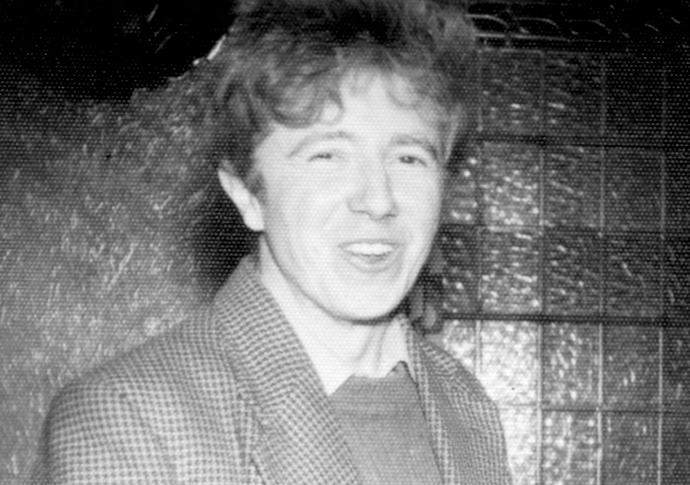
Bob in his younger days
Bob’s beautiful voice made him a key figure in the Sixties folk movement. In 1963, he was invited by Pete Seeger to perform at the Newport Folk Festival in Rhode Island. He performed alongside Bob Dylan who had met and sung with Bob when Dylan had been in London, and Joan Baez.
Many years later, Bob contacted the New Journal to say he had found tapes he had made after the festival with Seeger at the folk singer’s New York State farm. They had sat in Seeger’s barn and made music together, which was never released. Bob gave the tapes to the Tribune, and the newspaper passed them on to the library at Cecil Sharp House: the music was featured on BBC radio.
With musicians Hall, Plunkett and Paul Gross they performed concerts and recorded albums together, and ran the Fox, a folk club in Islington: Bob’s open-minded approach to booking acts saw him include Greek Cypriot musicians, New Orleans jazz and Ravi Shankar.
In 1963, Bob married Margaret Parker and the couple settled for a time in Chelsea before moving to Islington and then to Suffolk for a time. They had three children: Sarah, Ben and Joel.
In 1975, Bob paid tribute to the Irish music influence in the pubs in Camden he had sung in through his song, Wild Wild Whiskey: with its opening lyrics “When first to London I came down, I found employment in Camden Town, send money home and I did no wrong, till whiskey sang to me, its own sweet song…”
Its composition remains a seminal moment in modern, traditionally influenced English music.
In 1976, Bob settled back in Camden and married Jean Oglesby. They had a child, Katharine, and the couple lived in Calthorpe Street, King’s Cross. Later he would move to a flat in the Brunswick Centre.
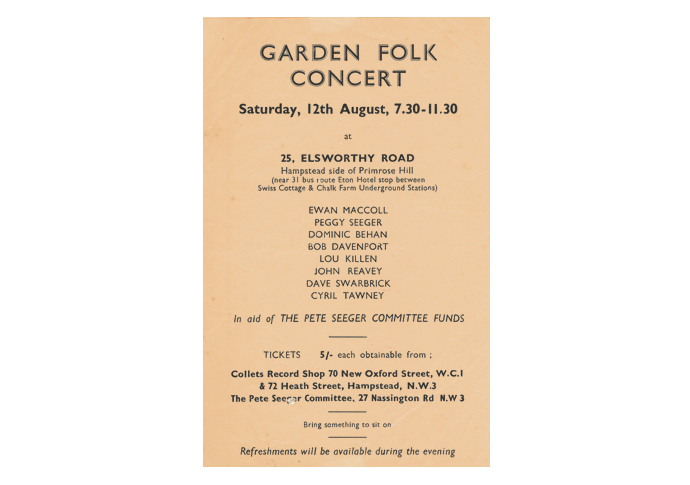
Bob on the bill for a folk concert at Primrose Hill in the late 1950s alongside the likes of Peggy Seeger and Ewan MacColl – tickets were priced at 5 shillings
Bob helped with various folk clubs throughout his life, including the Empress of Russia Club in St John Street, and other venues in Soho and Warren Street, and at the Unity Theatre in King’s Cross.
Bob did not ever want to rely on the vagaries of the music industry to earn a living. He worked in a record shop run by his sister Jane, and then as a chauffeur for the Guardian newspaper.
Bob loved poetry – favourite authors included John Clare and Thomas Hardy – and loved a bookshop, a trip to the cinema and theatre.
Politically astute, Bob used his voice to sing about life through a political lens.
He could hold a room with his vocal power and his quick wit. He was likened to Woody Guthrie for his championing of causes and his astute understanding of the history entwined with the music he sang.
Bob recorded albums throughout his career: the 1963 Sea Shanties and 1964’s Northumbrian Minstrelsy drew heavily on his north-eastern roots.
The Folksound of Britain, released in 1965, captured the mid-Sixties English folk revival.
For Bob, he would sing what he called traditional music rather than folk – folk was something middle-class Beatniks listened to, while he saw the music he loved as something with deeper roots that was for entertainment, not chin-stroking.
He was once asked by the Bonzo Dog Doo Dah Band if he would be their lead vocalist: he refused. Later he would sing with The Kinks and include Sunny Afternoon in his repertoire.
Later recording sessions included the 1997 album The Red Haired Lad and in 2004, he released The Common Stone which included collaborations with Martin Carthy, Richard Thompson and Chumbawamba.
Bob was such a draw that Bob Dylan snuck into his club in the 1980s incognito when he was visiting London: he could not miss the chance to hear Bob sing once more.
Bob, with his gentle smile, warm wit, and beautiful voice, leaves a rich music heritage and many, many friends.
He is survived by his five children, nine grandchildren, one great-grandchild and his half-sister, Jane.
