‘People were just put into homes for their whole lives’
Pat Stack was born with a disability at a time when healthcare options were limited
Friday, 19th December 2025 — By Caitlin Maskell
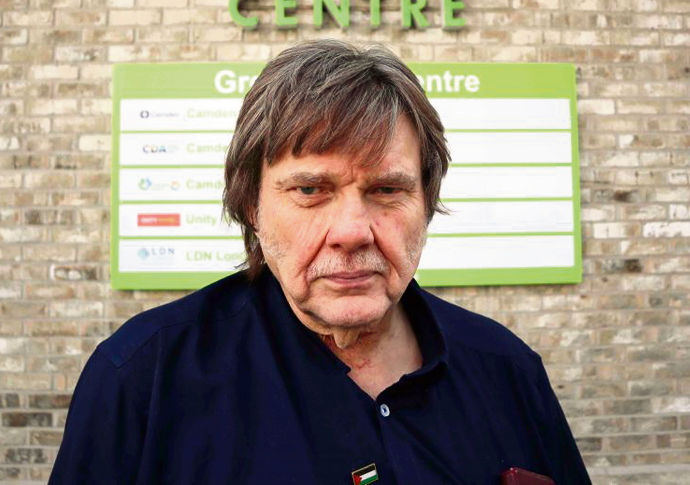
Pat Stack is chair of trustees at Camden Disability Action
HE has lived in Kentish Town since 1979, but Pat Stack’s journey into disability politics as chair of trustees at Camden Disability Action began decades earlier.
Mr Stack was born in 1953 in Cork, where his mother was a housewife caring for five young children and his father a police officer.
He was born with his disability at a time when healthcare options in Ireland were limited.
Born with no legs and one arm, he frequently travelled to England as a child for treatment at Roehampton, the major limb fitting centre that expanded rapidly after the Second World War to meet the needs of injured soldiers.
“My childhood was quite disrupted,” said Mr Stack, adding: “I remember being in the fitting room in Roehampton as a young child surrounded by men who had been through the war, I was maybe five. There was so much vital innovation at that time.”
Around the time Mr Stack was born, thalidomide was being widely prescribed for nausea in pregnant women. It later became apparent that the drug had resulted in severe birth defects in thousands of children.
Mr Stack said: “We’ve never been able to prove that my mother took the drug, but probably something similar happened to me.
“There were just a small number of cases in Cork around the time that I was born and years later we tried to investigate it but to find out what had been prescribed was impossible.
“Both that situation and after the war helped spur greater developments and innovation in limb prosthetics, but it is still very hard, nothing is perfect.”
Pat in his mother’s arms
Aged 17, Mr Stack moved to England and attended the University of Portsmouth and later Middlesex University.
“There wasn’t a disability movement in the way there is now so I had very little connection with disabled people unless I went to Roehampton.
“My life at that point was not primarily involved with other disabled people at all,” he said.
“I became very political and got involved in lots of activism, probably initially inspired by the Northern Irish civil rights movement. Gradually that drew me into the politics around disability.”
In 2000, he began working at Disability in Camden, a precursor to Camden Disability Action, which opened in 2015 and is based at the Greenwood Centre in Kentish Town.
He ran a department supporting people using direct payments – funding from the local authority for people assessed as needing social care, allowing disabled people to organise their own support rather than relying on council-provided services.
“It offered disabled people more choice, control and independence in their lives,” said Mr Stack.
“From my early days things have improved. If you look at the care environment, for instance, until well into the 60s large numbers of disabled people were institutionalised and put into homes for their whole lives.
“There was a gradual move away from that by trying to provide care in the home but even then there was a notion that the carers would determine your day, what time you would get up and go to bed and what things were priorities in your daily life. There was still an awful lot of exclusion from society for disabled people.”
Mr Stack said the Motability scheme had been life changing, allowing him to drive and take part in everyday society – one of a number of practical changes that, over time, have helped widen access and independence.
