Radical plan to tackle half-empty schools crisis
Spare space could be rented out under Town Hall proposals
Friday, 27th January 2023 — By Charlotte Chambers
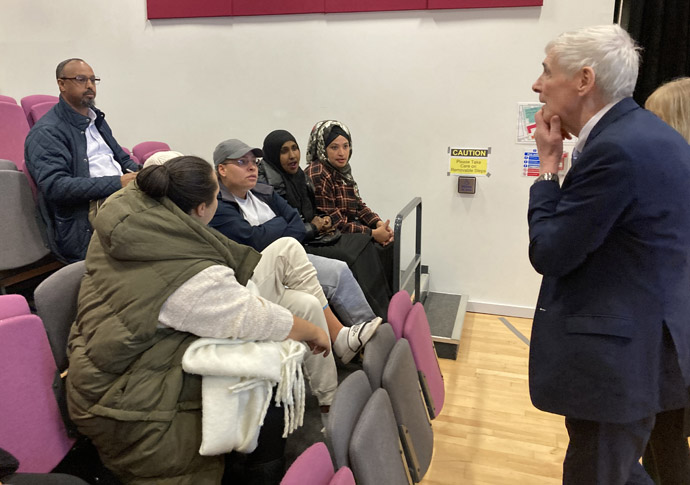
Islington Futures executive headteacher John Beighton speaking with parents in November about a school merger
MORE primary schools are facing drastic measures as the Town Hall grapples with a lack of pupils to fill places, figures unearthed by the Tribune reveal.
Our enquiries using Freedom of Information requests have found four primary schools in Islington are now half-empty, with 15 students on average per class. Another five primary schools have roughly seven unfilled chairs per class, while two secondary schools are just under half-empty in relation to the number of children enrolled compared to what they have capacity for.
Islington has now drawn up what it calls the School Organisation Plan (SOP), a response which could force schools to join together to share resources including teaching assistants, administration staff, caretakers and senior leaders. Another move could be to slash the number of places offered at undersubscribed schools and potentially rent out parts of the buildings – including caretaker houses – to the community or commercial tenants.
Over the last five years the number of unfilled places in primary and secondary schools has doubled from one in 10, to one in five, according to the alarming statistics released to us under the Freedom of Information Act.
Islington said it does not hold figures as to how many children who live in the borough are being enrolled in private schools. This data is collected in neighbouring Camden, where the figure is just under half.
Like many other London boroughs, explanations for the lower number of pupils have included a lack of affordable family housing. The Covid crisis also saw families relocate, as more people were able to work from home and could find cheaper properties outside London.
In its SOP, Islington launched a package of measures to address the issue of falling rolls in its 46 primary schools including closing and merging schools, “but only as a last resort”.
It stated before it considered amalgamation, it would reduce pupil admission numbers (PAN) at schools with greater unfilled places and then utilise parts of the building for community or commercial use.
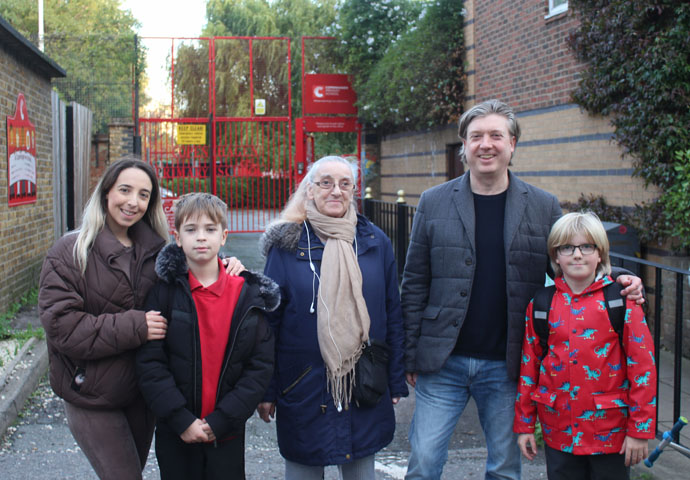
Parents and students from Copenhagen School in November
A press officer said: “Reducing the PAN enables schools to plan staffing levels and manage their budgets more efficiently. The council has recently consulted on reductions in PAN for a number of schools for the academic year beginning September 2024.”
Of the borough’s 46 primary schools, 26 are council-run, 14 are church schools (known as voluntary aided), four are academies and two are free schools. While the council has the final say over church and council schools, the education minister would have to step in over any plans for amalgamation or closure of academies or free schools.
A key prong of the plan to tackle unfilled places is to create federations – the joining together of groups of schools – amongst its 14 one-form entry schools.
Where schools enter into a federation they could be told to share specialist teachers along with administration staff and caretakers. In addition, they may be asked to share their special educational needs coordinator (SENDCO) with other schools in their group.
Last year the Tribune revealed that the primary schools Vittoria and Copenhagen, in Angel, are set to merge in September 2023 following consultation. A decision will be taken next month.
While the council argue they must make changes as schools are funded according to the number of pupils they have – and budgets get slashed by the government when their numbers fall – unions have called for a rethink.
Ken Muller, former secretary of the Islington NEU, said councils should join in the union’s call for the government to see falling rolls as an opportunity to improve education by welcoming smaller class sizes, rather than merging smaller classes together to re-establish the status quo of 30 children per class.
He added: “It’s outrageous that the government tell us we don’t need small classes – they say it’s the quality of teaching that matters, not the size of the class – and yet they’ve got double standards. One for the private schools with tiny class sizes they send their kids to, and another for everyone else.”
Education chief Councillor Michelline Ngongo said: “Across London, schools are seeing a reduction in pupil numbers, which means some places are not filled. Central government funds schools based on the number of pupils they have. Fewer pupils means less money to run the school, including paying for staff, goods and services, maintenance and other vital expenses.”
Most Islington teachers plan to walk out of their classrooms next Wednesday as part of a national strike over pay and conditions in schools.
One Finsbury Park teacher complained in last week’s Tribune that chronic, decade-long underfunding by the Tories had left schools in crisis, struggling to recruit new teachers and fighting to keep hold of experienced teachers as “morale in schools continues to sink”. A loss of support staff would exacerbate the situation, she warned.
