Review: Electra/Persona, at Lyttelton, National Theatre
Cate Blanchett and Nina Hoss star in ambitious production that pairs Sophocles’ classic Electra with Ingmar Bergman’s modernist film Persona
Friday, 4th September — By Lucy Popescu
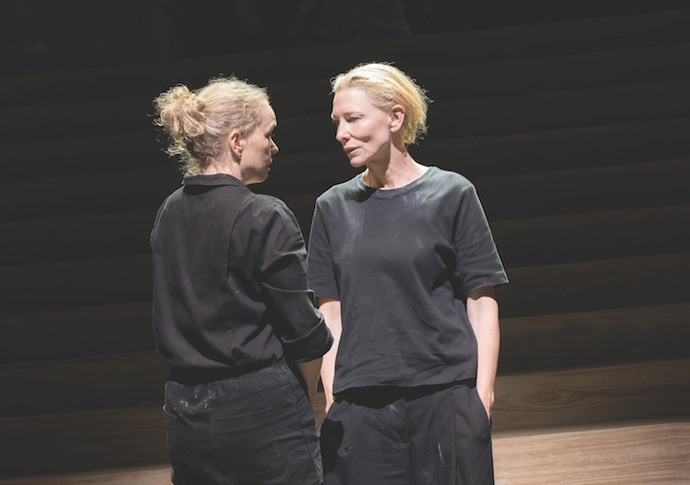
Nina Hoss and Cate Blanchett in Electra / Persona [Monika Rittershaus]
DIRECTOR and adapter Benedict Andrews’ ambitious new production pairs Sophocles’ classic Electra with Ingmar Bergman’s 1966 modernist film Persona, which explores the boundaries between our true selves and the outer masks we present to the world.
Each performance Cate Blanchett and Nina Hoss toss a coin to decide who will play Electra/Elisabeth and Clytemnestra/Alma, before theatrically covering their faces in white paint.
On press night, Hoss proved a powerful Electra full of frustrated grief and adolescent anger, wielding a hammer. Blanchett is hugely sympathetic as Clytemnestra, defending her corner and attempting to reason with her daughter. Bags of clothes are strewn over the stage and are adopted by the cast to represent absent figures such as Orestes and Agamemnon.
Ella Lily Hyland is an affecting Chrysothemis, Electra’s sister, desperate to restore equilibrium. Aegisthus (Patrick Robinson), Clytemnestra’s lover and co-conspirator, makes only a fleeting appearance but is memorably splattered with blood.
After a brief pause, the longer second half focuses on Persona. While playing Electra, actor Elisabeth Vogler suffers a breakdown mid-performance and stops speaking. She is sent off to recuperate at the seaside under the care of a nurse, Alma.
As Elisabeth remains withdrawn and Alma becomes more verbose, their two personalities blur. Andrews’ use of hand-held cameras feels a little old hat and the filmed sequence of the pair escaping down a theatre corridor echoes a similar scene from Ivo van Hove’s 2024 Opening Night.
Andrews’s staging, on Magda Willi’s majestic staircase, is magnificent and beautifully lit by Jon Clark.
The charisma of the two leads is palpable, and this uneven night of two halves is worth attending for their performances alone.
Until October 10
nationaltheatre.org.uk
