School rolls crisis: report is criticised over failure to call for extra funding
Education union has been pushing for inner-city schools to receive specific support
Friday, 18th September — By Amy Reid
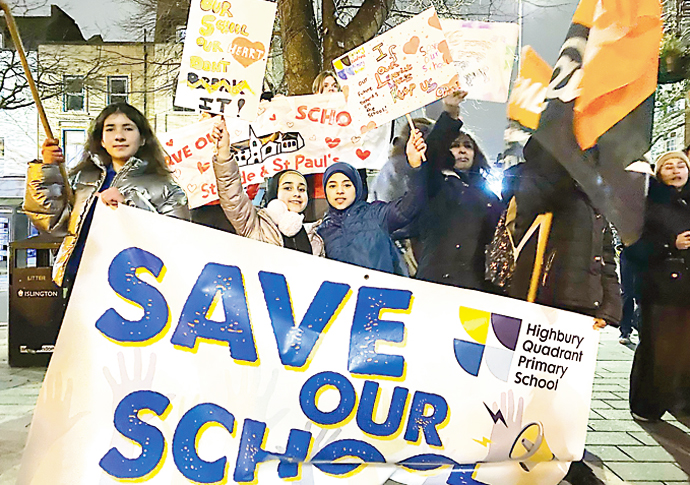
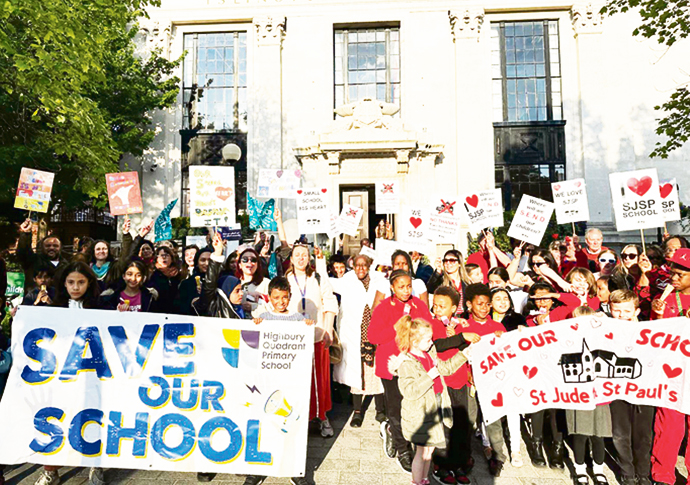
Pupils join protests over school closures after New North Academy was shut at the end of the last academic year, and maintained schools Highbury Quadrant and St Jude & St Paul’s (SJSP) closed last year
A NEW report led by Islington Council on how boroughs and the government should respond to falling school rolls has been criticised for failing to call for more funding to keep schools open.
Commissioned by London Councils, the research brings together case studies from across the capital, examining how councils have handled falling rolls and making recommendations on how consultation periods and pupil transfers can be managed more successfully.
Islington National Education Union (NEU) secretary Terry Sullivan said: “I’m really concerned that, in the report, there’s no actual request for more funding.”
Mr Sullivan said the NEU has been pushing for inner-city schools to receive specific funding to allow those with falling rolls to remain open, as small schools in remote areas do.
“[The government] recognises the importance of the fact that if you do not have a school in your town or small village, young families can’t live there. There’s dedicated funding. Why isn’t there dedicated funding for inner-city areas for the same process?” said Mr Sullivan.
“What we argue is that we shouldn’t close schools. The council doesn’t want to close the schools. The fact it’s led on the report is indicative of the fact they’re keen.”
He said it appeared the council had resigned itself to school closures being inevitable.
“It’s literally TINA: there is no alternative to this,” he said.
“I don’t think anyone’s thinking creatively about this. They just think we’ve got fewer pupils, we’ll just close the school. Closing the school is the damage.”
The report also recommends that the processes for closing maintained schools and academies should be “harmonised”. Currently, closing a maintained school takes longer and can leave parents and children in limbo for extended periods.
“The moment councils say, ‘we’re considering closing your school’, you lose anywhere between 10 and 30 per cent of parents literally overnight,” Mr Sullivan said.
The union rep fears the report is pushing for a shorter community school closure process.

Terry Sullivan
Council leader Una O’Halloran, who serves as executive member for children and education for the cross-borough organisation, told the Tribune the aim is to make both processes the same length, rather than shorten or lengthen either one.
Islington has seen several primary schools close in recent years, with factors including the high cost of housing blamed for the borough’s very low birth rate and falling pupil numbers.
Cllr O’Halloran told the Tribune that the research allowed boroughs to share knowledge and improve processes to minimise the impact school closures have on children and families.
She also told the Tribune of her commitment to working on rent controls and buying back ex-council housing in an effort to make housing more affordable for families.
New North Academy closed at the end of the last academic year, while maintained schools Highbury Quadrant and St Jude & St Paul’s (SJSP) closed last year.
“To be clear, none of the schools they’ve [Islington Council] considered have they changed their mind over. They’ve never changed it,” said Mr Sullivan.
“They talk about it being a transparent process. Now, we’d like it to be a fair and genuine process, and if every school that they consider, they then close, you think: this is not being genuine.”
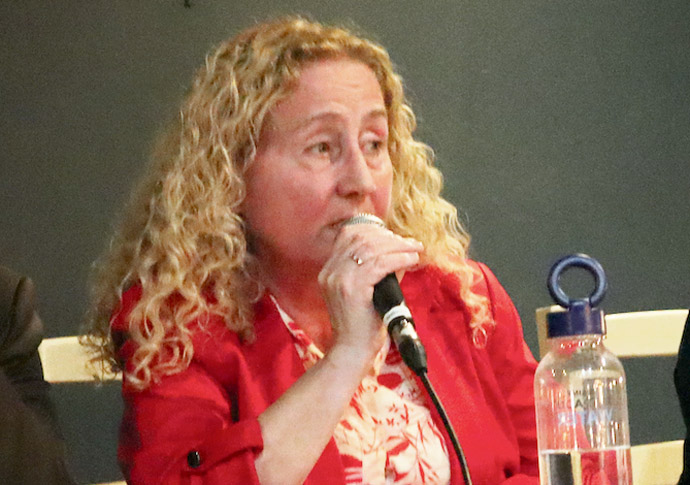
Una O’Halloran
After a long but ultimately unsuccessful campaign to save SJSP, parents were initially told the site would be leased to a SEND school. In what was branded a “betrayal”, site owner the London Diocesan Board for Schools sold the building to private school The Children’s House, which charges £7,644 per term.
Encouraging parents to fight to save the next school earmarked for closure will be much harder, Mr Sullivan argued, as no campaign has yet succeeded.
“It’s like, why bother fighting? Why take part in the consultation? It’s all just a bit of a sham,” he said.
“We’ve been very clear that closing the school is nothing short of educational vandalism. It rips out the heart of communities. But the point is, who suffers most? It’s those families who are most in need.”
Montanna Thompson’s son was a seven-year-old SJSP pupil when the church school shut down.
“It was really sad when they closed, and the kids found it hard to readjust and found it hard to get into new schools – all the kids did,” she said.
“We had this feeling of hope and we were all trying to save the school, but by the end it just felt like it was already destined.
“At the beginning, we were given false hope.
“We have mums now who are taking their children to two or three different schools on foot. It’s just crazy.”
