Step forward in plan for women’s centre
Campaigners and developers in talks over former Holloway prison proposal
Friday, 9th October — By Amy Reid
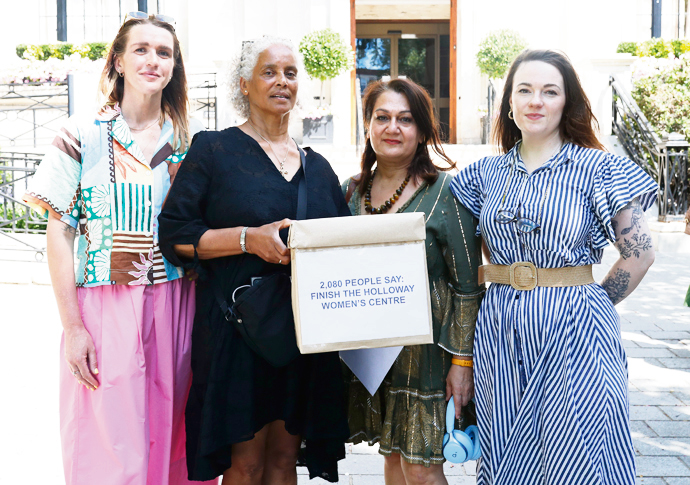
Jade Wye, Mandy Ogunmokun, Gona Saed, and Janey Starling outside the Town Hall [Daniaal Khalid]
THE future of the women’s centre at the former Holloway prison is showing signs of brightening as talks between campaigners and developers improve.
Housing association Peabody bought the women’s prison in Parkhurst Road after it closed down a decade ago, and is turning the site into a residential complex of around 1,000 homes.
Planning consents for the project require the housing association to provide a women’s centre which will offer support services to vulnerable women facing domestic abuse, sexual violence, poverty, trauma, addiction and homelessness.
The building itself was constructed, but progress stalled after Peabody and the council said they had struggled to find the funding required for both fit-out and operation cost.
A collective of women’s groups, including the Treasures Foundation, feminist charity Level Up and The Maya Centre, sent an open letter to the council in July urging them to push the project forward.
And talks around funding now seem to have taken a promising turn. Jade Wye, head of operations for the Treasures Foundation, one of the main campaigning groups, told the Tribune: “We need to hold Peabody and Islington to account, but just as they have a responsibility, so do we as a community.”
She added: “The only way I can see this being successful is if we work in partnership with Peabody instead of against them.”
Ms Wye added that she hopes more criminal justice services organisations will show interest in operating out of the site.
The news comes as women’s homelessness charity Solace conducts its annual women’s rough sleeping census. Islington is one of over 100 local authorities to partner with Solace and Single Homelessness Project on the survey.
Their 2025 census found as many as ten times more women sleeping rough in some areas than official government data identified. Women are often excluded from homelessness figures because they survive in places official counts overlook such as public transport and A&E.
Many women walk around all night to avoid danger which can also lead to them being missed by official counts recording numbers of people bedded down.
Kathryn Parsons, public affairs manager at Solace, told the Tribune that women’s only support services are key in helping local authorities reach vulnerable women.
“The current approach of only offering mixed sex accommodation isn’t working,” she said.
“And so from a cost perspective, that in itself is inherently wasteful, because women are often being placed in places and then leaving, so the bed isn’t being used either way…it would be more sensible to have women’s only provision and be able to keep women safe and resolve that homelessness earlier.”
The Town Hall’s housing chief Labour councillor Jason Jackson said the census produces “practical intelligence” that can inform Islington council’s efforts to reach vulnerable women in the borough, adding: “As a local government, the right funding is always a challenge.
“But look, the current government are giving us the right soundbites and also actually showing some action. We don’t want that to be a temporary thing.
“No one should be rough sleeping in a country like the United Kingdom. So I think everyone buys into that and we’re doing all the best we can as Islington.”
When asked about the status of the women’s centre at the old jail site, he said: “All I can say about that is that we have an agreement in place that was agreed as part of the planning that there will be a women’s centre in Holloway Park. They [Peabody] have actually identified a group that could do that. That process is what we leave with Peabody because that is the agreed terms in terms of their promise of delivery.”
A Peabody spokesperson said: “The Women’s Building is under construction as part of the wider Holloway Park development and is expected to be completed in 2028.
“We’re continuing to work with the council and other partners, including the Women’s Building Collective and CIVA, to identify a provider and develop a long-term, sustainable operating model for the building, including arrangements for its fit-out and funding. Those discussions are ongoing.”
