‘Thank you, Dr Burke’, the health service’s first black psychiatrist
Dr Aggrey Burke, the pioneer who exposed racism in medical schools, died aged 82 just before Christmas. Samantha Harding pays tribute to an inspirational mentor
Friday, 9th January — By Samantha Harding
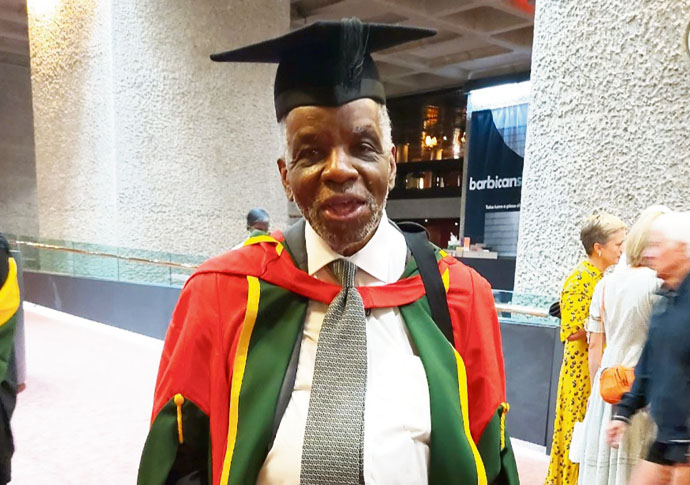
Dr Aggrey Burke
WHEN I first began applying to UK medical schools, little did I know I was ticking all the wrong boxes.
I was female, I was Black and I had no idea that I was up against a selection system deliberately stacked against me.
So when I finally succeeded after multiple rejections and years of trying, I asked the medical school admissions tutor what had made the difference this time.
His answer was simple: “Aggrey Burke.”
This answer encapsulated my great mentor and friend who has died aged 82. Not only had this eminent consultant psychiatrist stepped up to personally vouch for me, but his groundbreaking paper, exposing the deliberate bias that then existed in London medical school selection, had also played its part.
Today I am a consultant eye doctor because of Aggrey Burke and his quiet, unassuming advocacy.
He was a friend of this paper and its late editor, Eric Gordon, my husband.
When the Royal College of Psychiatrists decided to honour Aggrey in 2019 for Black History Month, Eric wrote about that 1985 paper, in the Journal of Medical Education, in which Aggrey and his colleague, pharmacologist Joe Collier, exposed active discrimination against Black, Asian and female entrants to St George’s Medical school using a computer algorithm.
The Commission for Racial Equality launched an investigation and both men were ostracised by the medical establishment.
Aggrey would often recall to me the machinations to thwart his progress at every turn after he was appointed Britain’s first Black consultant psychiatrist in the NHS in 1976.
His work and standing should have seen him made a professor decades ago but this never occurred.
By the time I became a medical student at St George’s, between his insightful lectures I watched as he lost first his secretary, then his desk and then his office at the medical school.
He was eventually to retire continuing his work around racial justice and transcultural psychiatry and suicide. Along the way he had been a founder member of the African Caribbean Medical Society (ACMS) with David Pitt, later Lord Pitt of Hampstead a fellow doctor in 1981.
Born in St Elizabeth, Jamaica, Aggrey came to the UK aged 16 and enrolled to study medicine at the University of Birmingham in 1962. He then trained at the University of the West Indies in Trinidad and Tobago, returning to take up a post in Forensic Psychiatry at St George’s in 1976.
He naturally became interested in the psychiatric impact of discrimination and racism on the mental health of African-Caribbean people in the UK.
This was to culminate in his involvement in the 1981 New Cross Fire protest, when 13 young Black people were killed in a fire during a house party in south London.
He took up the vital role of supporting the families who had lost their children in the tragedy which, at its height, brought more than 20,000 Black Londoners out to protest on the streets.
It was fitting when, in 2022, he was awarded an honorary doctorate by St George’s Hospital Medical School for his contribution to the field of psychiatry and “as a pioneering campaigner against discrimination”.
In 30 years I had never heard him raise his voice, and in his lilting Jamaican accent, he used his acceptance speech that day to show his wit and skill as a raconteur, recalling his life and career.
As a final legacy, a fellowship in his name was inaugurated by the Royal College of Psychiatrists to encourage Black medical students into psychiatry in 2023.
As is so very Aggrey, he closed the speech accepting his honorary doctorate so simply: “Thank you, madame President.”
We can all safely say: “Thank you, Dr Burke.”
• Samantha Harding is a consultant opthalmologist who lives in Primrose Hill.
Tributes to a trailblazer
THERE was no shortage of tributes as the sad news came in that Dr Aggrey Burke had passed away on December 21.
The Royal College of Psychiatrists described Dr Aggrey Burke in an online post as a “legend”, adding: “His legacy will continue through the Aggrey Burke Fellowship, supporting black medical students in psychiatry since 2023.”
Noclor, the NHS research office, said: “He spoke and wrote thoughtfully about race, migration, institutional bias, and the realities faced by black communities, always encouraging mental health services to listen more carefully and act more fairly.
“Through his advocacy and scholarship, Aggrey challenged the profession to confront uncomfortable truths, reshaping debates on ethics, equity, and responsibility within British psychiatry.”
New Beacon Books in Stroud Green Road and the George Padmore Institute also shared heartfelt tributes, while scores of messages from friends and admirers were left on social media sites.
