The ‘little forest’ at Highbury Corner is about to go
Sunday, 4th October 2020
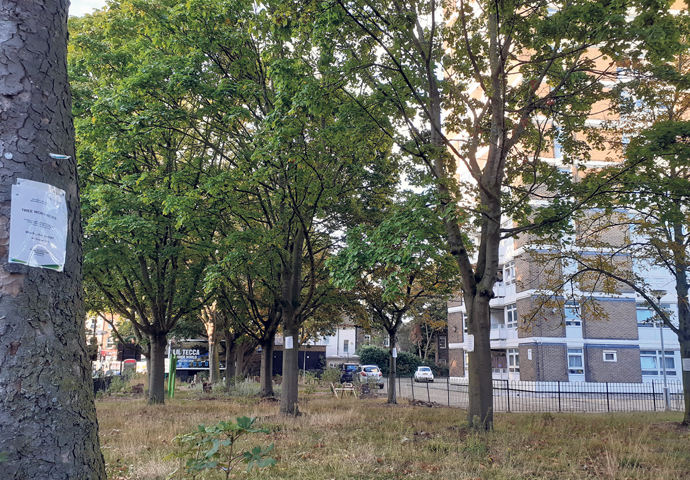
‘The ‘little forest’ on Dixon Clark Court’
• “WE are fortunate to work in naturally ventilated studios with a view of mature trees… opposite” – home page of Hackney-based architects Burrell Foley Fischer (BFF).
By contrast next Tuesday, October 6, work will begin to remove seven mature trees from Islington Council’s Highbury Corner “little forest” on Dixon Clark Court (DCC).
The trees are to be destroyed and replaced by a six-storey block of 14 leaseholder-flats, part of a new housing development across the estate.
A proposal to save the trees by shifting the residential block further along the site was dismissed out of hand by housing boss Cllr Diarmaid Ward and ignored by the project’s architects.
Yep, you’ve guessed it – BFF – also a member of the “UK Architects Declare Climate and Biodiversity Emergency” group.
Without a hint of irony, BFF’s online promotion of its DCC housing scheme refers to “the busy, noisy Highbury Corner roundabout”; since its recent reconfiguration, busier and noisier than ever, and exactly where a natural buffer is needed to protect residents and children on their way to the nearby primary school from the racket and pollution of passing traffic.
Instead a hard-standing block will replace the trees and front directly on to Canonbury Road.
But the irony continues: “A significant increase in the number of trees on the site… will more than compensate and exceed the few trees lost as a result of the proposals”.
As a former senior Islington Council conservation officer and signatory to the tree-campaign group’s letter, published before lockdown, reminds us: “One mature tree is worth 10 saplings”.
Advising DCC residents some weeks ago that building works are to begin on October 12, the council failed to mention the tree works but continued to spin the misleading statement that the 41 new-homes scheme contains “27 much-needed council homes”.
As two of DCC’s existing council dwellings are to be reclaimed as storage areas, this means a net increase of 25 additional social homes.
An earlier request that the planning committee minute be amended properly to record and clarify this matter was ignored by both the housing boss and the council’s CEO, (How many new homes was that, Islington?, July 31).
Trumpian “alternative facts” should play no part in Islington Council’s record-keeping.
Some councillors continue to take any opportunity to sneer at residents who’ve campaigned to save the trees, smearing them on Twitter as being “privileged” and opposed to council housing.
They know who they are but, blinded by ideological arrogance, clearly don’t care about the damage they’re doing to the council’s reputation.
Much has been learnt about the worldwide climate emergency and biodiversity loss since permission for this housing scheme was granted two years ago, and the inflexibility of the parties involved to redesign the development accordingly is deeply regrettable.
Poet, and now professor, Benjamin Zephaniah has been in correspondence with Brenda McHugh, wife of Conor who founded the campaign to save the trees, but tragically and unexpectedly died in April.
He recalls “one summer sitting underneath [the trees] with a group of other poets before a gig in a pub nearby”.
In less than a week the trees will be gone.
We could do worse than ponder Gaspard, “the handsomest fox in London” and wonder if she spent time in the “little forest” on the way to her favourite local garden, (Book deal for Gaspard the friendly fox, October 2018).
Now with a family of her own, she, like many of the children from Canonbury primary and other adult mammalians, cannot but miss the loss of this soothing, pleasant, corner of an otherwise toxic neighbourhood.
In memory of Conor McHugh.
MEG HOWARTH
Ellington Street, N7
