The Man With the Plan
A new film about the historic Beveridge Report throws light on the continuing importance of his work, as Douglas Beattie discovered.
Thursday, 24th September — By Douglas Beattie
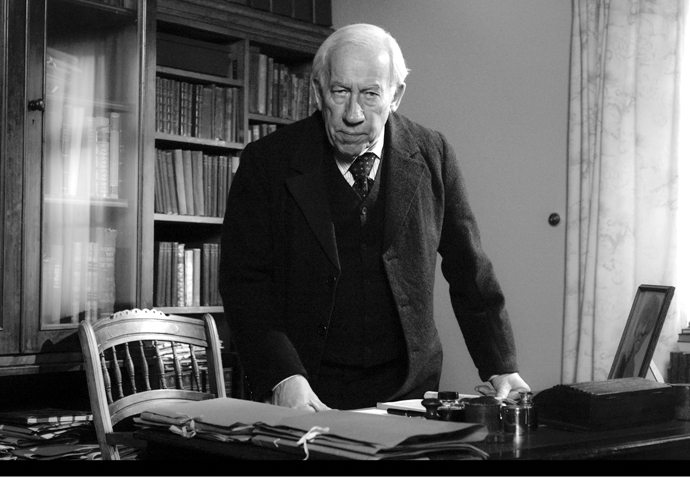
Simon Callow as William Beveridge
THE remarkable thing about The Man With The Plan is that it conveys an urgent message, not from the period following the Second World War but about the needs of the country today. It is simply this: we have yet to build a Britain that provides the basics the entire population requires to live decent lives.
The timing of the film could not be more fitting, for here we are with a new prime minister in Andy Burnham and a high-profile by-election taking place in Holborn and St Pancras, until recently the seat occupied by a certain Keir Starmer.
Burnham has already highlighted the need to reverse the neoliberalist approach that has largely been in vogue since Margaret Thatcher’s time in office. Yet, while undoubtedly this is something the government should pursue, the film tells us this alone is not enough.
Witten and directed by Christine Ezard and produced by Olivier Stockman for Sands Films Studio, this is a drama in which a young woman goes on a fantastical journey uncovering the famous report of 1942 by the social economist, William Beveridge.
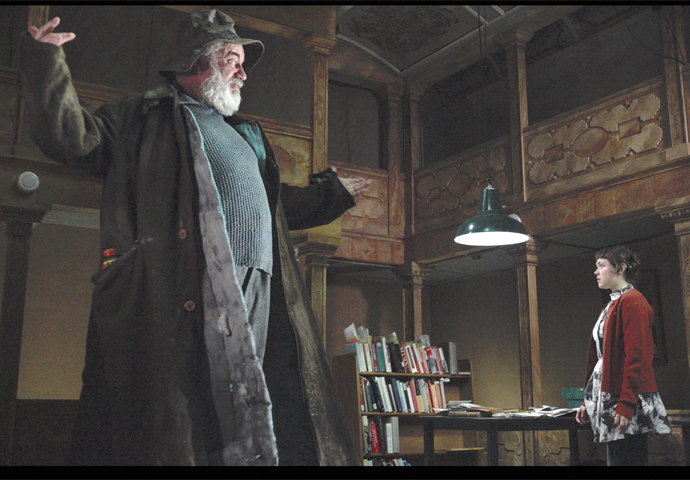
Neil Gore as Want and Sophie Jenkin as Flea
In the film Beveridge, superbly played by Simon Callow, appears both firm and furious. Firm that what he identified as the “five giants on the roar to reconstruction” – Want, Disease, Ignorance, Squalor and Idleness – had to be conquered; and furious that this has not taken place.
Even at this distance it’s impossible to overstate the impact of Beveridge’s work. Released in the middle of the war under the curiously mundane title “Social Insurance and Allied Services”, the report exploded into the public consciousness, selling 600,000 copies in just over a year.
This was a document of deeply radical intent with which Beveridge intended to spark what he termed “a British revolution”. It embedded the idea that the chains of inequality had to be smashed if we were to prosper as a nation.
Much of this was a long time in the making, having sprung out of the growing sense in Victorian society that far too many people lived under conditions of great hardship. For instance, in the 1880s the social reformer Charles Booth discovered that more than 30 per cent of the population of London – and in some areas up to 60 per cent – lived at or below subsistence level. Poverty, wrote Booth, had become “a national institution”.
To this we may add broken promises about what Lloyd George had called “a country fit for heroes” at the end of the Great War; then the terrible privations of the 1930s following the Wall Street Crash, with monstrous levels of unemployment.
Quite understandably, Beveridge caught the mood of the times, with even Conservative-supporting newspapers giving their backing to his plans, and The Economist calling the report “one of the most remarkable state documents ever drafted”.
The difficulty today for many on the left may be that we consider Beveridge a success because his work gave rise to the NHS, a cradle-to-grave social security system, nationalised industries and millions of council homes. Certainly, with Labour in power between 1945 and 1951, his vision helped improve millions of lives and continues to do so to this day.
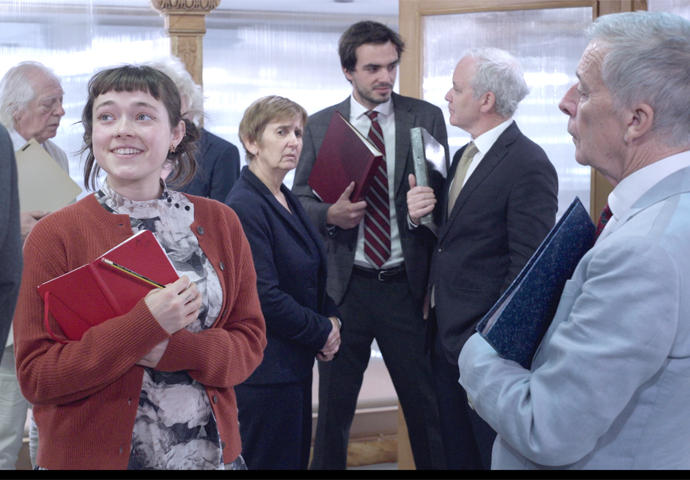
Sophie Jenkin as Flea and politicians
Yet, mainly through Sophie Jenkin, who gives a strong performance as Flea, the student at the centre of the film, it becomes apparent that Beveridge’s ideas were not only never fully implemented but have since been dramatically eroded through a lack of political will and the growing influence of private companies on public services.
“Think of the cost. Just think. Think of the cost,” a herd of MPs shout at Flea about fully ridding society of Want and the other giants.
Yet this is a clever rhetorical device employed by the film-makers, for the more we hear it the more apparent it becomes that the real cost is the human cost of failing to act.
Beveridge in the film (his words are used verbatim) as though speaking to us about today’s situation, calls on the government to “take steps to ensure at once that no child in Britain need go cold and hungry, because there is not enough family income”.
Though there are many aspects on screen which are troubling, including the dangers of AI, the film is also uplifting. In the final scene campaigners come together to state their case on the environment, housing, water quality and more.
One speaker, Professor Sir Michael Marmot, gets to the heart of the matter, telling us that “Beveridge is not just possible; it is essential.”
The Man with the Plan can be seen nationwide and will be in Liverpool just as Labour’s annual conference is about to kick off. As the film-makers point out, it would be a good idea for the entire cabinet to go and see it. You should see it too.
• Screening details at: www.sandsfilms.co.uk/the-man-with-the-plan.html
• Douglas Beattie is the author of Victory at the Ballot Box: The History of How Labour Built Britain
