‘There is a constant sound like a boiling kettle’
The volume at gigs can cause severe hearing problems – so says guitarist and tinnitus sufferer Tim Bricheno. Dan Carrier listens to his sage counsel
Friday, 30th January — By Dan Carrier
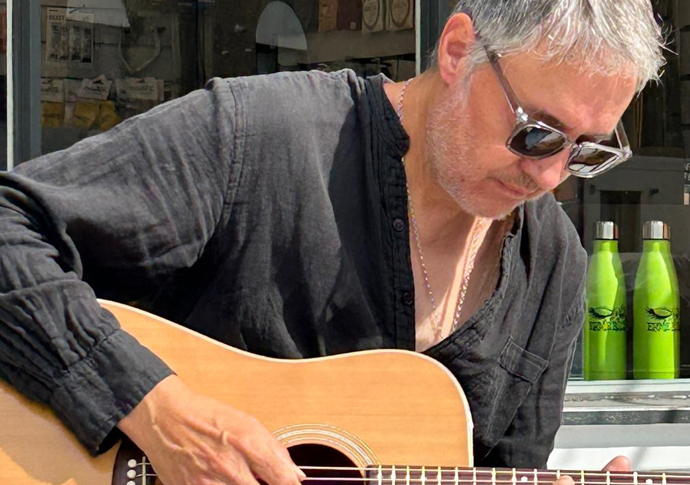
Tim Bricheno
IF the decibels played at your average concert or club were found in a factory, the workers would down tools and the management would be convicted for dangerous practices.
That is the danger music fans face every time they head out to see their favourite band of DJs. Now a celebrated guitarist is hoping to raise awareness of the issue.
For musician Tim Bricheno, whose career spans hit-making ensembles such as All About Eve and Sisters of Mercy, peak volume has had a long-term and serious impact.
As cranking everything up to 11 seems to be the natural reaction to tunes we love – a culture of louder the better for everything from bassy reggae to incessant House music, screeching guitar rock to immersive jazz – there is a serious public health issue that is too often ignored.
Tim suffers from the debilitating hearing injury tinnitus, the result of loud studio sessions and stadium gigs.
Today, he has managed to find a way to continue working in the music industry and is an ambassador for the Tinnitus Association.
In February the charity is hosting a Quiet Night Out – a gig featuring Justin Sullivan from New Model Army, musicians from The Penguin Club, Cosmo Pyke, Kate Ireland and more, with the added bonus of educating people about the dangers of excessive noise and supplying gig-goers with state-of-the-art, reusable ear plugs.
“My experience is pretty typical for a musician who has tinnitus,” says the Kentish Town-based guitarist. “It started in 2019. I was at a rehearsal with a young band I was helping out. It was their first time in a recording studio and they were very excited. They were playing really loud and I thought ‘that is very, very loud,’ but I went along with it. I left and I had tinnitus in my ears. I’d had it before when I’d been at a loud gig or a club and you find by the following morning it has gone. This time it just stuck around. There is a constant sound like a boiling kettle.”
He was diagnosed with noise-induced tinnitus, a condition that means he hears a constant high-pitched sound created by the brain attempting to make up for lost frequencies. Tim also has a condition called hyperacusis. “It means massive noise sensitivity. Your ear amplifies everything and it is just full on, all the time.”
Thankfully, with help, sufferers can adapt to the condition – but it takes time.
“Initially your brian is on high alert – something has been damaged and your body is reacting. It is there when you go to bed at night, there when you sleep, there when you wake up in the morning.”
He hopes music lovers will understand the dangers. “When I was at the height of my success in the 1980s and 1990s, no one thought about hearing damage. No one wore ear plugs,” he says. “Today, there is still widespread ignorance across the music industry and among gig goers.
“To be clear – wearing ear plugs is compulsory if you do not want hearing damage. The volumes we are exposed to are just too loud for you to cope with. It is luck if you get away with it.”
Research into hearing loss has led to health and safety laws in the workplace that limits volumes and insists on ear defenders. But the same does not apply at venues.
“You go to a rock concert and it is as loud as using a road drill,” he says.
This danger hiding in clear sight has moved Tim to use his platform to educate people.
“I started looking at how many musicians had damaged their ears. Concerts are often just not at safe levels. I thought, ‘Let’s do a concert where sound levels are safe and can be enjoyed without risking damage, and raise money for the charity and raise awareness’.
“There is a problem with trying to regulate sound levels. Turning down the volume is unsexy. However, if you use ear protectors, you don’t have to turn it down, you still feel the music, feel the bass. It is a simple message: you can still enjoy the power of the music but, crucially, not damage your hearing.”
For tinnitus sufferers, hearing aids can help, as by increasing what you can hear turns down the internal sound – but not for Tim because of the hyperacusis sensitivity.
“The biggest help I had was for the emotional impact, and changing the way to react to it. I saw a clinical psychologist,” he says. “There is a physical and emotional side to audiology. You cannot fix it but you can help manage it. It has been life-changing.”
As a musician who had spent months on tour playing at sell-out stadium gigs, accepting he could no longer do so was one element. “I had to stop my work for a long time,” he says. “I had a job writing music, which was really enjoyable, but long hours in the studio each day. I found music just so painful to listen to. I am back in the studio, though I can’t do it the same way as I used to. I can’t do live performances. It’s just too loud. And going out to a noisy bar or club – I just can’t do it any more.”
Tim has had to adapt and manage. “At first, I was in despair – it was like an iron curtain coming down over night. But thankfully it didn’t happen when I was younger and touring. It would have been devastating. I have learned how to adapt and find different ways to make music.”
Ensuring gig-goers can continue to enjoy live acts is at the heart of the message. “If you work in a building site or in a factory, it is the law to wear hearing protectors – but not at gigs, which are just as loud,” he says.
“Music makes a nice sound, so volume is all too often ignored – but with volume comes risk.”
