‘Thrilled’ Walter tracks down mum’s song – with a little help from the Tribune
Islington man ‘kept looking year after year after year’
Friday, 30th January — By Daisy Clague

Walter Roberts
AFTER years spent searching for a song his mother sang when he was a child in India, a man from Islington has finally identified the tune thanks to an article in the Tribune.
And now we’ve tracked down the artist too.
Playing with his siblings in the garden of their house in Bangalore in 1958, Walter Roberts listened to his mother, Maria, singing along to the radio.
He never forgot that particular tune, and although Maria wrote its lyrics in a notebook of her favourite songs, that was soon lost to time and no one could remember who the ditty was by.
Shortly before his mother died in the Whittington Hospital in 2020, Mr Roberts discovered the tattered notebook in a box of keepsakes at his home on the Brecknock Road estate, and contacted the BBC, the British Library and our newspaper to see if anyone recognised the lyrics.
“I kept looking year after year after year, and this year I was looking up the same lyrics and found that somebody else was looking for it too, and mentioned the Islington Tribune article,” he said.
His fellow researcher had tracked down the song and there, in a post on the folk music forum Mudcat Cafe, Mr Roberts’s search finally came to an end.
It was My Mother, by Laurie London, a 14-year-old child star whose recording of He’s Got the Whole World in his Hands rocketed him to the top of the charts in 1958.
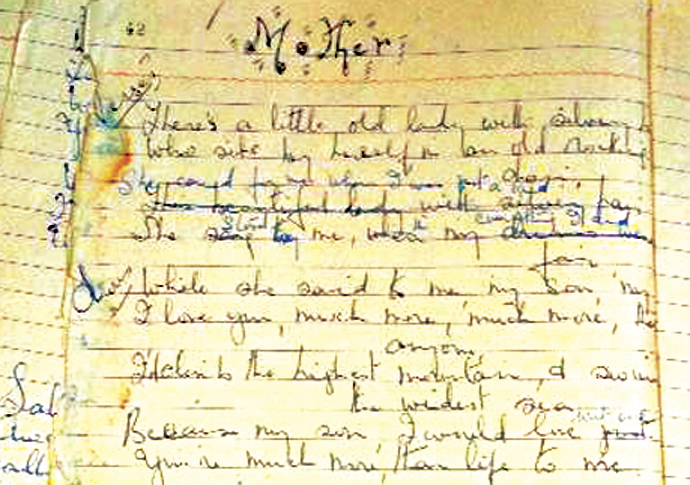
Lyrics written in a notebook by Mr Roberts’s mother Maria
Mr Roberts was thrilled. “I didn’t ever think the singer could be a 14-year-old boy,” he said. “He had such a mature voice, tremulous, with a particular timbre. He was probably the first teenager ever to crack Abbey Road Studios, long before the Beatles did, but then for some obscure reason he faded. But it’s big time for me that he is still alive.”
After his debut album, Laurie London disappeared from the public eye – but this week the Tribune tracked him down to relay Mr Roberts’s story.
Mr London, now 82, joked that “if he still remembers hearing that song on the radio after all these years he should be home in bed”.
He told how his musical talent was discovered in the 1950s at the Earls Court Radio and Television Exhibition – an event to showcase consumer electronics – which had a stage upstairs where celebrities were performing. During a lull in the show, the band leader asked if anyone in the crowd wanted to come up.
Thirteen-year-old Mr London said yes.
“He handed me this beautiful, expensive guitar, and after I sang one song they asked me to do another. One of the hostesses grabbed me by the arm and introduced me to the producer, and he said ‘would you like to come back every day and sing up here?’”
On the second day, Mr London met a song plugger from EMI Records, and the rest is history.
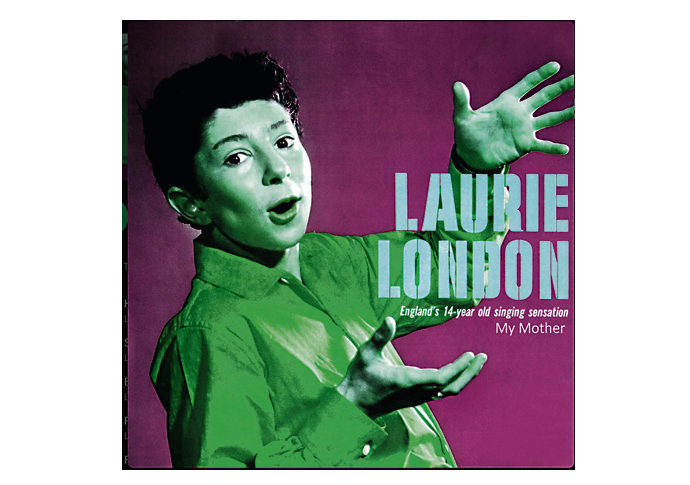
Laurie London’s My Mother compilation from 1957
“I never got overly excited about it,” he told the Tribune, adding: “It was something nice, but I didn’t get an overblown idea of myself.
“The business wasn’t as hectic as it has become. By law, I wasn’t allowed to do too much. To work abroad, I had to go with my father and my agent in front of a judge and apply for a licence.
“So I’m lucky in a way, I was allowed to ease into it and just enjoy it.”
Mr London still performs as a guest with his friends in the swing band Jive Aces.
When Mr Roberts identified My Mother as the song he remembered from childhood, he noticed that Blues legend Buddy Guy also had a writing credit on the track, along with Mr London. But when we put this to Mr London, he said he had “never heard of him” and wrote the song at home himself – a mix-up by the streaming giants, it seems.
My Mother includes the lyrics: She said to me, my son, my son / I love you, much more, much more than anyone / I’d climb the highest mountain and swim the broadest sea / Because my son, my beloved one, you’re much more than life to me.
Mr Roberts said: “For me, my mother climbed mountains and swam oceans – so much suffering she went through, she’d go hungry knowing she could feed us first.
“She was a beautiful singer, she could crest the wave of any octave. I would listen transfixed when I heard her sing.”
He told how she had been a wireless operator during the Second World War, and would sing to the soldiers when they returned from the front. “I would say to people, if they have got mothers and fathers, do something special. Show them that you love them. Never leave it too late,” he added.
