Troy story: The Odyssey feels like a return to Hollywood’s Golden Era
Christopher Nolan’s take on Homer’s epic poem is rumoured to have a huge price tag – it is money well spent
Friday, 17th July — By Dan Carrier
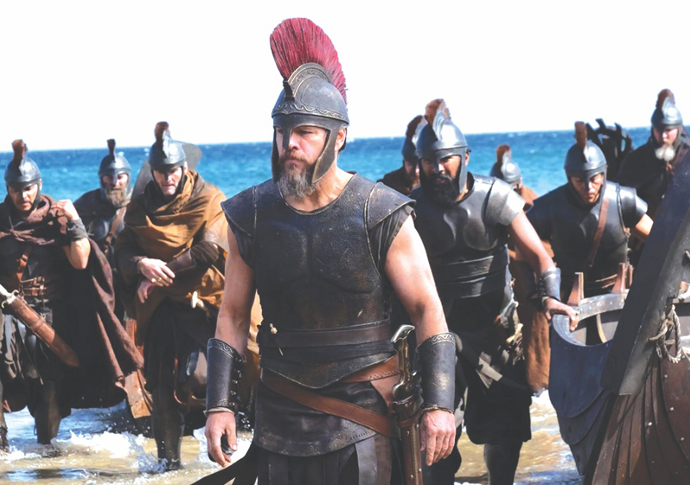
Hero worship: Matt Damon in The Odyssey
THE ODYSSEY
Directed by Christopher Nolan
Certificate: 15
☆☆☆☆
WHEN Joseph L Mankiewicz sat in his director’s chair and began ordering Elizabeth Taylor and Richard Burton about on the set of Cleopatra, the bean counters at 20th Century Fox were prepared for an expensive ride. The 1963 film cost, in today’s money, around £500m, and nearly bankrupted the studio.
It is said that Christopher Nolan’s take on Homer’s epic poem has a similar price tag. It is money well spent.
Nolan’s Odyssey visually feels like a return to grandiose storytelling from Hollywood’s fabled Golden Era. It would sit comfortably alongside Cleopatra, Ben Hur, Spartacus, Alexander the Great and The Ten Commandments.
Odysseus (Matt Damon) is the king of the Greek island of Ithaca. He has been off laying siege to Troy. He’s used the fabled horse to vanquish his enemies, but getting back home to his queen Penelope (Anne Hathaway) is not straight forward. En route he has to tackle a series of challenges and take on a troupe of mythical beasts.
Meanwhile, on Ithaca a gaggle of usurping suitors are trying to persuade Penelope her fella is never coming back and it’s time to choose a new king.
His son Telemachus (Tom Holland) wants to protect his mother and find his dad. Baddie suitor Antinous (Robert Pattison, showing he can do a wonderfully evil turn) hangs out at court, hoping to break Penelope’s spirit and take the crown.
What works is how each trial builds up tension while we know what’s happening back home. Standout moments include the sailors’ voyage to the island of Aeaea, inhabited by the witchy Goddess Circe (a brilliant Samantha Morton). It is done with a heady mix of fairytale-like fantasy and utter seriousness.
This film is a sensory overload. At times the sound mix was overwhelming, and made scenes hard to follow as the dialogue was swallowed up by crashes, bangs and wallops.
As a child of the Ray Harryhausen era, the CGI is over the top: Nolan could have scored an easy win if he had mimicked such mythological adventures as Jason and the Argonauts in design. Instead, modern technology equals superslick effects and it demeans the power of a viewer’s imagination rather than sparks it – we have very little heavy lifting to do.
But these are minor niggles. Homer’s poem was an epic, and this Nolan film is too.
