What can you do with a degree in ecology? Go out to work on the Grand Union Canal
Ben Macmillan keeps a careful eye on the ecosystems of the industrial waterways
Friday, 28th August — By Dan Carrier
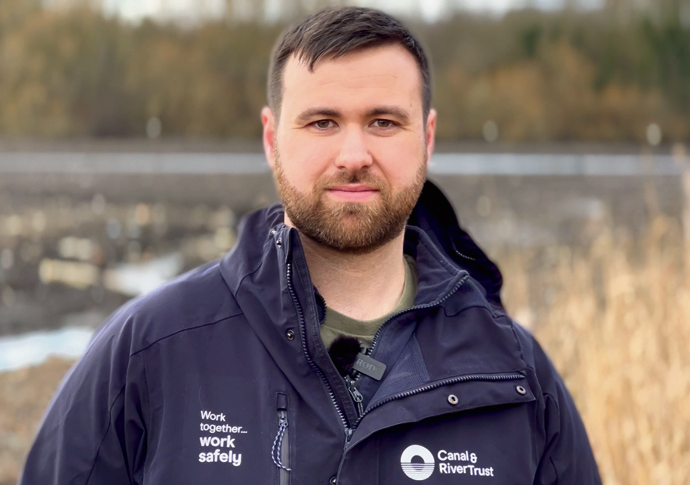
Ben Macmillan
STUDYING science does not always lead to a job wearing a white coat in a laboratory: for Ben Macmillan, his degree in natural sciences – he studied ecology – has led to hands-on work outdoors.
Ben, who studied at Salford University in Manchester, is now the head of ecology for the Canal and River Trust in London and the south east. His role is to keep a careful eye on the ecosystems of the industrial waterways – monitoring and supporting its biodiversity as it snakes through the city.
Ben’s first role when he left university was to work on planning applications, monitoring the impact of development on our natural habitats, writing reports for builders to use to offset any damage projects might create and ensuring new developments were wildlife-friendly and beneficial to the environment.
In 2023, he took on the role as an ecologist of the Canal and River Trust. He now oversees London’s 160 miles of canal network.
He said: “I was always interested in wildlife growing up and after graduating I went into ecology conservation for planning and development.
“I helped put together surveys that check for biodiversity and ecology, things like the populations of animals. We would look at plans and then write a report to recommend enhancement measures.
“I have always wanted to make things better than they were previously. Sometimes that is not possible – for example, when you lose a lot of grass habitats it can make it challenging but developers now have to pay to offset that, and do mitigation.”
His current role ranges from monitoring water quality through to protecting wildlife and enhancing the waters to encourage biodiversity.
“I really love it – I work for a charity that has a real impact on the natural habitat,” he says.
“Working in a fresh water habitat has been a new challenge I enjoy. There are 2,000 miles of canal in the country and I focus on London canals, from Rickmansworth through to London, and then half way up the River Lea.”
And what were once industrial waterways to move cargo have become vital corridors for wildlife.
As well as supporting the obvious species – fish and wildfowl – canals play host to a huge range of other animals.
“Bats are a key indicator species and they rely on the canals as a corridor,” he says.
“Canals have limited artificial light and that is a vital aspect.
“They are dark – they do not have as much urban light pollution – and these dark corridors help with foraging. This makes them vitally important in London. They connect different areas and let species move to find food and to breed.”
And a range of native species have made the canals their home.
“It is an important refuge,” he adds.
“The water quality – given the state of our waterways and rivers today – meant they have considerable value.”
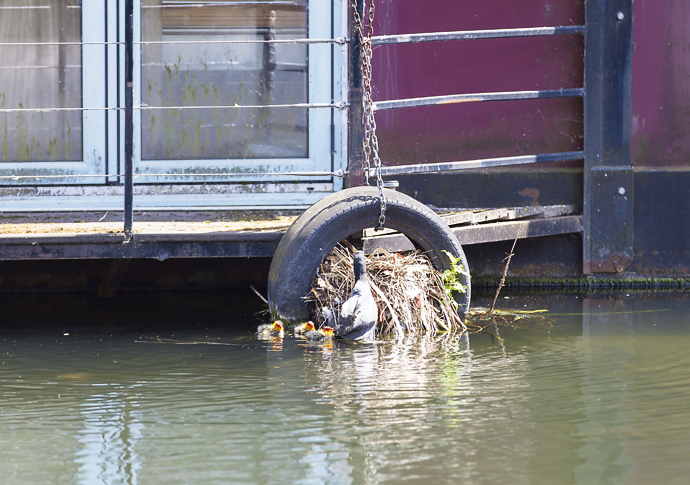
Waterfowl nesting on the canalside
Canals had been used in the past for overflows and as part of urban water management systems. That means they have to be carefully watched.
“In London, sewage outlets can be really quite problematic,” adds Ben.
“They increase nutrient levels in the water and this has a knock-on effect by helping non native species take hold.”
Anyone who regular walks along the Grand Union or Regents Canal will recognise the green carpet of floating weed that occasionally appears. Called floating pennyworth, the dark green plant is a major issue for the canal teams.
“They are a gift from the Victorians,” says Ben.
“It comes from South America and was brought over to go in ornamental ponds. It likes slow moving waters, like canals, and it can grow up to 20 centimetres every day.
“We spend £400,000 a year in London alone removing it to maintain navigation and help protect other species. If it is left to its own devices, it will thrive with high levels of nutrients – and if left alone it would cover the canal in basically a massive blanket, taking away the light and starving the water of oxygen. “It would kill fish and native aquatic flora.”
Ben and his colleagues employ contractors to scoop the weeds out of the water using a mechanical grab, similar to a digger.
“We have an extraction strategy that starts with the River Lea and is working through the canal network,” he adds.
“We focus on areas between locks, and use a grabber like a bulldozer to scoop as much out as we can. Then we can isolate patches.”
But the weed is so prevalent, after the bulk has been removed, volunteers come in to finish the job.
“We have to make sure we take away any fragments left,” he adds.
“The weed is so tenacious it can grow back from just one small fragment so you have to remove it all completely. Leave any behind during one growing season and it will come back again.”
Other plants that cause problems include giant hogweed, whose sap can cause blisters and can grow up to 5.5 metres high. Each plant can produce 50,000 seeds. They also face a challenge posed by Himalayan balsam, which grows in dense patches and starves native plants of light and water.
Other invasive, non-native species include creatures such as the American crayfish, a reddish brown creature that looks a little like a lobster.
“They are well established now in our waterways and difficult to get rid of,” he says. They threaten the native whiteclaw crayfish, so managing their numbers is important – but not easy.
“You can use traps but they do not catch the smaller ones, so by removing the larger ones you actually encourage the population to thrive.”
Ecologists have found ways of helping wildlife thrive. Ben and his team create reedbeds that have numerous benefits. They act as filters to keep water quality good, provide shelter for wildfowl and fish, attract pollinators and other insects.
And the canal also is home to other species that are not obvious city dwellers. Red-eared terrapins are spotted, left in the canals by people who can no longer keep them as pets. While there have been reported sightings of terrapins laying eggs. The reptiles need temperatures to be above 30 degrees for 60 days for eggs to incubate, so despite this summer’s heat waves, the chances of terrapins reproducing in the UK is not yet reality. However, there is a colony of snakes called the Aesculapian – a tree-dwelling reptile found near London Zoo. The Zoo says the snake’s proximity has nothing to do with them, and it is said the creatures first came to the canal after escaping from a nearby laboratory.
“They are non-native but are found in Europe,” adds Ben.
“They are not considered to be breeding and they are not competing with native species, but we do keep an eye on them.”
My life on the Lock, by man who keeps Victorian waterway flowing
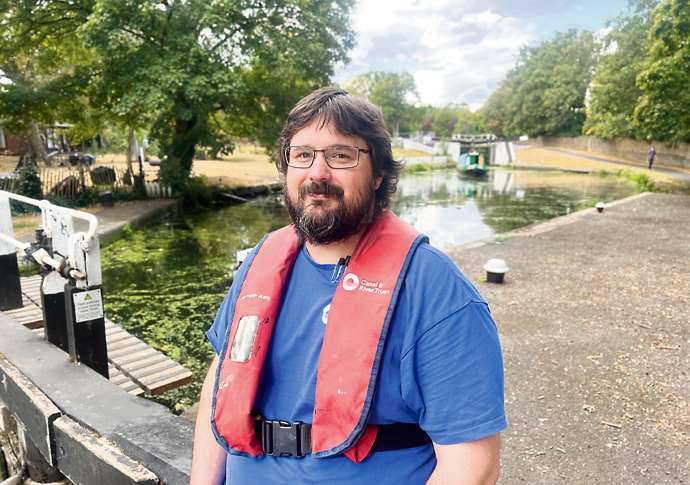
Nicholas Jones from the Canal & River Trust
ON top of ecology and conservation, managing the canals requires a team to undertake daily checks and ensure water levels are maintained, locks are working and sluices are open or closed.
Nicholas Jones is the area operations manager for the Canal and River Trust – and it is his job to oversee the smooth running of the urban waterway. He uses science to monitor water levels and water quality, to promptly respond to any pollution issues. His post-graduate work saw him do a masters in environmental history – and he researched a herd of elephants in South Africa that were allowed to roam free by colonial authorities in the early 20th century.
“During World War 1, the price of barbed wire went up and so farmers started hunting herds to protect their crops,” he recalls.
“It was then herds became protected and national parks were established.”
From big safari animals to checking water levels,
Mr Jones’s canal domain runs from Rickmansworth through west London to Little Venice and into Camden. “I work with the operations team that looks after maintenance and structures – the locks, sluices and weirs,” he says.
“It takes careful monitoring and management to make sure the canal water levels are at their right height – difference of just a few inches can impact on both wildlife and canal users.
“If we have too much water in one section we open up a sluice to the flow, and let it run off into the Thames or one of the other rivers the canal is linked to.
“Or, if a section does not have enough, we have to make sure we can take more water to the right point.. Sometimes water is lost through negligence – for example, not closing lock gates – and if the level drops significantly we have to take immediate action.”
The climate crisis can impact the canals and there can be an increased danger of flooding. “Two months ago, we had a deluge where we had one month of rainfall in four hours,” he said. “ That sets everything out of kilter. We had to move water make sure our sluices were open and operating. And the same challenges come when there is a drought. We try to maintain water levels through ‘pounds’ – stretches of water between locks.
“Generally, the levels are determined by eye. We walk the towpaths, but we also use electronic monitoring stations to confirm our inspections.”
The water levels should not be over topping onto the tow path, nor too low that boats cannot navigate the waterways.
“There is a rule of thumb: if you fell into a canal, the first thing you should be able to do is stand up. In the middle, at its deepest, it is about up to my chest and I am six foot tall. The middle is an navigable channel and towards the banks, it is shallower. We try to avoid dredging. It is expensive and can damage biodiversity.”
The water quality today is decent. Fish such as perch, carp, tench and pike are thriving and Nicholas and his team ensure they monitor the water and keep it clear of pollutants and debris.
“We have a duty to ensure it is navigable. We have monitoring stations across the network , and we use them to ensure there is uniformity. The canals are not static. They flow towards the east because of the gradient. It is not quite the same as a river, but there is a flow and we have to monitor that and ensure it is steady.”
By carefully watching the health of fish, they can check the water is clean. “Last year we found a case of eel herpes, which is an indicator of poor water quality. It shows if you don’t have the right flow it can impact on the wildlife,” he said. “We also act when we get reports of blue–green algae blooms. It can kill fish so we act by oxygenating the water. If we see fish in distress that can be evidence of poor oxygen. We work closely with ecologists and we can run compressed air in to oxygenate the water. Having a waterway through densely populated areas produces its own challenges. During the Victorian era of heavy industry in London, the canal was not just a route for traffic and cargo but as a watery dump for factories and industrial effluent. That has long past, but there are still issues to tackle.
“On the Paddington arm we had a recent case of a dark kitchen dumping cooking oil into the canal. Luckily it was during the winter and it stayed in clumps so we could clear it up.”
