Why disabled people are feeling under attack again
Sense of the tide turning backwards after decades of campaigning and calling for change
Friday, 19th December 2025 — By Isabel Loubser
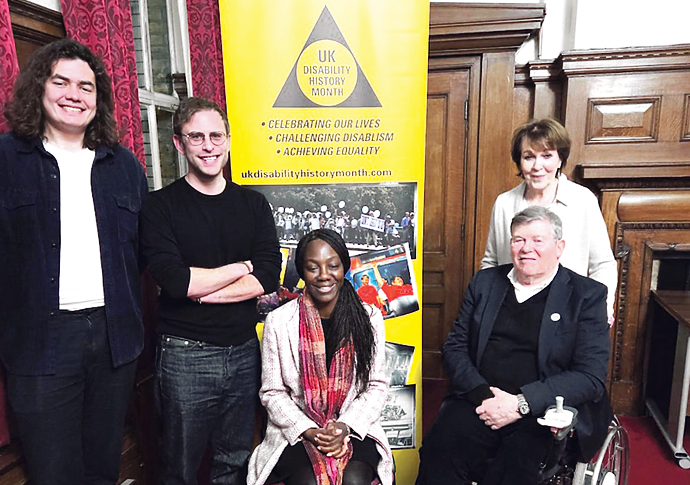
Richard Rieser (right), who first organised UK Disability History Month in 2010, says this has been a particularly difficult year for disabled people
DISABILITY rights activists have told us time and time again that this year has been especially tough. For many, after decades of campaigning and calling for change, they sense the tide turning backwards – returning to a time that once seemed firmly in the past, a time when disabled people were labelled “scroungers” and were not seen as equal to those who were able-bodied.
Every year, the Islington Tribune marks UK Disability History Month with features that highlight the challenges, and also the achievements, of disabled people in our borough and further afield.
This year, placing a spotlight on those people is perhaps more important than ever before.
Over the past 12 months some believe the government has tried to attack disabled people by making it more difficult for them to claim Personal Independence Payment (PIP) and, most recently, changing the Motability scheme so that it will be more expensive for users to lease a car.
There is one man who has sensed this change keenly, and this week he warned that it will now take more than a hundred years for disabled people to be given true equality.
Richard Rieser, who lives in Newington Green, first organised UKDHM in 2010.
“We did it because we had made some progress under the 1997-2010 government, but all of that was reversed,” he said, adding that measures taken by successive governments had eroded rights of disabled people and made their lives “significantly harder”.
Mr Rieser told the Tribune: “Everywhere you look, things are actually deteriorating. We don’t value disabled people’s lives in the same way as other people.”
The theme of this year’s UKDHM was “Disability, Life, and Death”, and Mr Rieser, who relies on crutches after contracting polio as a child, spoke on the topic last Thursday at a meeting in the Town Hall. He explained that disabled people had died disproportionately during austerity and Covid.
“Austerity was a shocking approach,” he said. “It’s the sort of economics that does not recognise that there are certain human values that should underpin our policies. It looks like Labour are taking that same approach now.
“It’s been established by all sorts of groups that people die because of cuts by the DWP. Some starve or commit suicide.”
It has been a particularly difficult year for disabled people, Mr Rieser said, as the government sought to cut PIP.
He added: “It costs 40 per cent more to live as a disabled person. You have to pay for extra heat, clothing, transport.
“This is what PIP covers and it was that that the government targeted. They confused it with an extra disabled unemployment benefit. They still haven’t disentangled their wires on that one.
“The government have adopted such an uncaring attitude. They don’t treat us as if we are equal.”
Mr Rieser said he feared the knock-on effect that these attacks had on the public perception of disabled people.
“Hate crime goes up across the board every time government ministers start attacking disabled people and the tabloid press start attacking us as ‘scroungers’,” he told the Tribune.
“Labour had a plan to have complete equality by 2025. Well, we’re nowhere near that, and it will take more than a hundred years to get there.
“We won’t reach it because of the new politics of the far right.”
Mr Rieser added: “I know what we have got for disabled people, we’ve got through our collective efforts of protest and drawing public attention to it.
“If we want progress, we will have to keep campaigning.”
