Council’s ‘serious failings’ as social housing landlord
Inspection report reveals more than 1,000 lifts waiting for repairs
Friday, 15th May — By Finn Logue
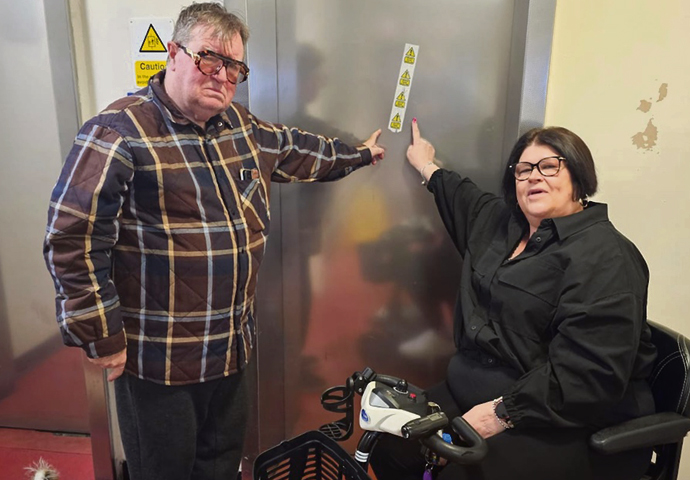
Gary Bendle and Alison Proderick from Finsbury Estate where a broken lift has been affecting residents
ISLINGTON Council has been found to have “serious failings” in its responsibilities as a social landlord across its council housing stock, a new report has revealed.
An inspection in winter 2025 by the Regulator of Social Housing (RSH) identified a number of issues within the council’s social housing management, suggesting it falls short of delivering high standards for its residents.
The report states that the council “does not have an accurate understanding” of the needs of its social housing tenants and their homes. Additionally, the RSH revealed there were more than 1,000 overdue lift remedial actions in council houses across the borough, which were not suggested to be a priority for the council, despite the effect they have on residents.
It is not the first time the council has been identified as having shortcomings on its social housing management. A separate “special investigation” report in October 2023 by the housing ombudsman resulted in fines of tens of thousands for its “disjointed” approach to dealing with residents’ complaints.
At the time, the council said it was “committed to delivering” improvements in its housing service in the long-term.
Callum Waterhouse, from housing union Acorn, said that the findings were “shocking”. He said: “Islington Council is often quick to trumpet the quality of its housing stock and its record as a landlord, so it’s very concerning to see this record is built on such shaky data. Lack of action on lift repairs is particularly shocking to see when faulty lifts regularly leave older or disabled residents stranded in their homes for days on end. The council needs to take immediate action to make sure its tenants are living in homes that are safe and accessible.”
Faulty lifts in council housing are a recurrent topic of coverage for the Tribune, with many residents expressing their frustration at a lack of urgency in having them fixed.
Last month tenants in the council-run Finsbury Estate in Clerkenwell told the Tribune that their needs were being neglected by the council, and an out-of-service lift was causing significant distress to vulnerable residents with disabilities. The council told residents they would not be fixing the lift until June at the earliest, despite it being out of service since February.
Alison Proderick, who lives on the Finsbury Estate and has COPD and osteoathritis, said that the report highlights that social housing across the borough is a “mess”. She added that she hoped they would take broken lifts more seriously.
Councillor Benali Hamdache, leader of the Islington Green Party, said: “It is concerning that Islington Council has been found to not only lack accurate information about the condition of its homes, but often has not surveyed homes within the last decade.
“It has 1,000 overdue lift remedial actions, and Greens on the council have raised concerns regarding the poor performance of old and newly installed lifts.
“These failures have very real impacts on Islington’s residents, particularly those with limited mobility and chronic health conditions who depend on lifts.”
Councillor Hamdache added: “It doesn’t have to be this way: other London councils like Hammersmith and Fulham have received the regulator’s top grade.
“We will work constructively with the Islington Labour administration to improve the council’s systems and ensure tenants are living in the safe homes they deserve.
“What we urgently need now is a fair funding settlement from this Labour government and a new approach from the council.”
Council leader Una O’Halloran, said: “We take the Regulator of Social Housing’s judgement seriously and fully accept that improvement is needed.
“The findings highlight weaknesses in how we understand the condition of our homes and how we assure ourselves on safety data, and that is not good enough.
“This is not about a lack of commitment, but about systems and assurance that must be stronger.
“We had already begun an improvement programme before the inspection, and we are now accelerating that work, with clear accountability and close engagement with the regulator, to make sure residents have safe, decent and well-maintained homes.”
