Demand for school exclusions review as more black children are sent home
Experts warn that suspended and expelled pupils are more likely to become involved in knife crime and targets for grooming by gangs
Friday, 16th October — By Finn Logue
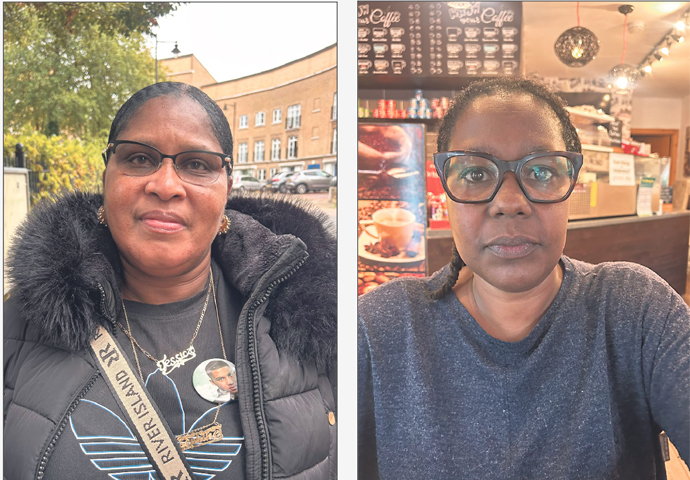
Left: Jessica Plummer, whose son Shaquan Sammy-Plummer died in a stabbing, and Councillor Elmedina Baptista-Mendes
“HARMFUL” levels of suspensions and exclusions for black children in Islington pose a serious risk to safeguarding, experts have warned, urging that more attention must be drawn to the issue.
The Tribune previously reported how a “crisis” of suspensions and exclusions across secondary schools was hindering the education of children with SEND.
Figures from a recent Town Hall report show that this issue is also disproportionately affecting black and mixed-race Caribbean pupils.
Here the rates of suspension were identified to be significantly higher than the London average, at which Islington sets it benchmark.
The numbers in the council report identified that the vast majority of suspensions were for “disruptive behaviour”, but there is no further breakdown of what this constitutes.
Experts have warned that suspended and expelled pupils are more likely to become involved in knife crime, and become targets to be groomed by gangs when outside of the classroom.
Jessica Plummer, who lost her son Shaquan Sammy-Plummer to knife crime 11 years ago, now works with at-risk excluded and suspended children at schools and Pupil Referral Units across Islington and London as part of her youth work.
Speaking to the Tribune, she said: “The problem is that when kids get excluded from schools, they tend to go outside and do bad things because they’re looking for attention. And especially black kids, they feel that nobody is listening to them. When I talk to them, they say that they don’t feel accepted because of the colour of their skin.
“They might have a difficult home life. But when they are not in school, hanging around, that is how they get groomed.”
Ms Plummer added that she felt everybody, “including the council and the schools” needed to “come together” to provide better support frameworks instead of constantly “punishing” disadvantaged children.
Councillor Elmedina Baptista-Mendes, who works as a child safeguarding nurse and sits in the Town Hall’s children’s scrutiny committee, said that a deeper “investigation into the figures” was needed.
She told the Tribune: “This is a safeguarding issue because when you keep a child away from learning, you not only are endangering their professional future life, you’re battling against their dreams and aspirations. We don’t want these children outside of the school, we want them in the classroom.”
She urged the council to explore where there may be “overlaps” between different groups of suspended children.
“We know how high the numbers are for both black children and children with SEND, so why aren’t we seeing more research into whether these are linked, whether they are the same children?” she added.
“These are your children, your residents, and your families. This is a complex issue with lots of moving parts, but every moving part, including the council, needs to do their best.”
Maud Waret, a National Education Union rep and a teacher at City of London Academy Highgate Hill, said that the decision-making processes for suspensions and exclusions comes from above, and teachers do not have a say.
Ms Waret said: “What I can say is that teachers do not have any influence over who stays and who leaves. And sometimes, that is heartbreaking, because we know if we had a plan in place, we could really prevent these children from falling through the cracks.
“We are very much aware that they’re in more danger when they are expelled, so it can be very frustrating as an educator, because you would like to keep the child.”
Ms Waret said that while she felt exclusions and suspensions were sometimes necessary for the protection of teachers and pupils, she would like more “democratic” processes to decide on punishment.
She said that a more “holistic” approach should be taken, adding: “We are dealing with human beings with complex needs. I don’t just think we should look at the numbers, we should look into the systems in play and how they can be modified.”
Councillor Sheila Chapman, the Town Hall’s children’s chief, said: “We’re working tirelessly to ensure that every child in Islington receives the right support to learn and thrive in safe environments.
“We know that some groups of children are over-represented in suspensions data and we take this issue seriously; we were one of the first local authorities to take action in this challenging and complex area.
“The borough-wide position also masks very significant variation between schools, a pattern that is reflected nationally.
“We are strengthening our analysis to identify which groups are affected, where repeated suspensions are occurring and what is driving them.
“We’re having honest discussions with our schools and academy trusts, identifying bias wherever it is found and focusing on solutions that reduce suspensions and embrace an inclusive approach to education.
“This includes supporting schools to identify needs earlier so they can put in place appropriate support before difficulties escalate.”
