Excluded! Anger over worsening rate of special needs pupils being sent home
Report reveals troubling statistics on suspensions in the borough’s schools
Friday, 25th September — By Finn Logue

No More Exclusions protest in central London
PARENTS of children with special needs have told of a rapidly worsening yet “unnoticed” crisis of suspensions and exclusions in Islington’s secondary schools.
Town Hall statistics revealed that over 75 per cent of pupils with Education, Health and Care (EHC) plans – some of the most in-need in the borough – had been dismissed from the classroom in 2024/25. The inner London average, Islington’s benchmark, is 28 per cent.
The troubling statistics were revealed in a Town Hall report which also outlined how a quarter of all students had been suspended at least once that year. Nearly 50 per cent of all students with special educational needs and disabilities (SEND), some without EHCPs, had been suspended.
The Tribune has spoken with multiple parents, teachers and campaigners who said they felt mainstream schools in the borough were simply unable to manage the needs of SEND pupils because of a lack of funding and targeted support.
The result, they say, is that children are being banished from the classroom and, crucially, missing out on their education.
Amal Abdullihi’s son Khalil is in Year 10 at St Mary Magdalene Academy. He has an ECHP for autism and ADHD, and his mother said that every day at school has been a “battle” since his start three years ago. She regularly receives phone calls from the school asking her to collect him from the front office, or to let her know he has been removed from class and internally excluded in “isolation pods”.
She said: “This whole thing is having such a big impact on both of our mental health. Khalil is such a polite and positive child, but of course due to his needs, at times he gets dis-regulated whilst at school. Instead of having proper support systems in place to help him through this, the school just send him home or remove him from class.
“And then he is just sitting around, doing nothing, and missing out on his education.He gets so down because of it. He is made to feel like he doesn’t belong at the school, like they are trying to force him out because he is different.”
Ms Abdullihi added that she felt the academisation of schools in Islington had created a vacuum of support for the most disadvantaged pupils.
“Basically every school in the borough is now an academy.” she said. “Which means they don’t have to follow the rules of the local authority and can suspend as many students as they like. The result is that our children’s voices aren’t being heard.”
Over the past three years, she said, Khalil’s self-esteem had taken a battering. It has reached a point where he sometimes now refuses to go to school in the morning due to anxiety.
Concerns have been raised as to whether suspensions are an appropriate method of managing behaviour, with research from the National Education Union showing that suspended pupils are twice as likely to become engaged in knife crime later in life.
Minda Burgos-Lukes, an Islington-based activist who volunteers and advocates for campaign group No More Exclusions (NME), told the Tribune that a “punitive” approach to SEND pupils was seeing suspensions and exclusions “snowball”.
“Schools, especially academies of which there are a many in Islington, take a ‘zero-tolerance’ approach to behaviour,”she said. “It’s so unfair, because a blanket approach does not work, they are all individuals and deserve to be treated as such.”
Ms Burgos-Lukes said she felt that suspensions and exclusions were “built into the culture” of schools, both in Islington and more broadly.
The group are campaigning for a national pause on suspensions, in order to rewire the disciplinary approach taken within schools and prevent future harm to students.
Sharron Mangum, an educational psychologist who volunteers with NME, said there has been a long “suppression” of the needs of SEND children in mainstream schools.
“There’s a crisis taking place amongst children with SEND. Schools are meant to be sanctuaries, but there is a lack of understanding for these children and their unmet needs are resulting in punishment, when schools should be taking a step back and having a wider look at how to deal with these behavioural difficulties.” she said.
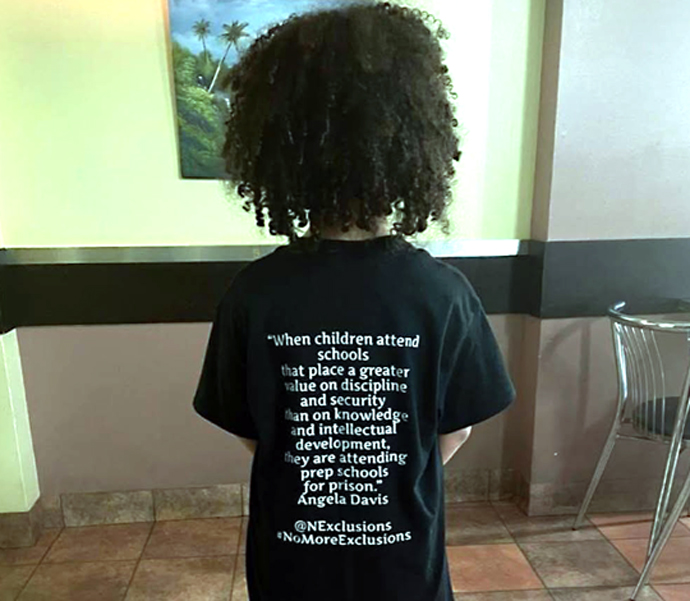
Protesters want a rethink on school exclusions
Both Ms Mangum and Burgos-Lukes identified that many of the issues that are resulting in such high numbers of secondary suspensions begin in primary.
While the levels are significantly lower than in secondary schools, dismissals in Islington’s primary schools still climb higher than the London average.
Chris Turner told the Tribune how her autistic and ADHD son had been “failed” and “neglected” by staff at St Joan of Arc primary school, after he was repeatedly suspended and internally excluded from as young as seven years old.
Eventually, after months of time away from the classroom and unsuccessful attempts to reintegrate him, she decided to move him to another school.
She said: “The school removed him from the classroom for months on end. He was so anxious constantly.
“It’s not fair, he was so young. To dismiss a child with special needs at such a young age, I think it is really cruel.”
In a response for this article, a spokesperson for St Mary Magdalene Academy said: “While it’s not possible to comment on individual situations, we’re committed to maintaining our very low exclusion rates. As the data shows, our exclusion rate is significantly lower than the national average, particularly in the case of SEN students.”
A spokesperson for St Joan of Arc school said: “Our school is deeply committed to providing an inclusive, safe, and supportive environment for every child. Our approach to behaviour and inclusion always considers a child’s individual needs, ensuring appropriate reasonable adjustments, multi-agency support, and tailored interventions are put in place wherever required. We work extremely hard to support pupils, whatever their needs, and are proud of their achievements.
“The school cannot comment on individual cases.”
