‘Horrifying’ chicken ruffles feathers!
Animal rights activists place ‘Frankenchicken’ outside Upper Street coffee shop
Friday, 19th June — By Isabel Loubser
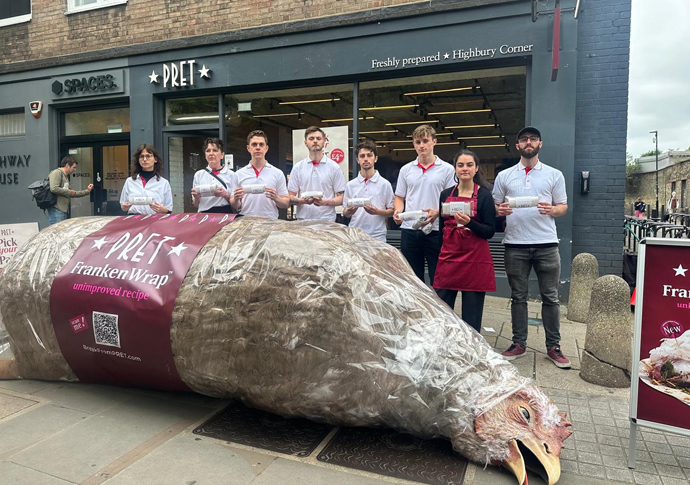
Anima campaigners and the ‘Frankenchicken’ in Upper Street
AN enormous animatronic “Frankenchicken” was laid in front of Pret A Manger in a stunt designed by animal activists to shame the store out of selling fast-growing chickens.
The four-metre-long wrap was installed outside the coffee shop in Upper Street as passers-by were urged to “take a break from Pret” until they commit to phasing out the artificially large feathered birds.
Connor Jackson, chief executive of Anima, the campaign group behind the stunt, told the Tribune how customers were “surprised” when told about Pret’s behaviour.
“That’s not how they present themselves. You pick up the sandwich, it’s nice branding, it says ‘responsibly sourced’, it’s quite expensive, you expect there to be high quality products in there,” he said.
Pret has made a commitment to adopt slower-growing chickens into its supply chain.
This month they committed to starting the phase-out in 2031, but campaigners say this is just an excuse to make no immediate change.
Mr Jackson said: “They keep assuring the public they are committed to better chickens, but actions speak louder than words. They’ve been delaying this for eight years for no reason, they could have done it four or five times already. Waitrose have done it, and instead of taking action they’ve just kicked the can down the road until 2032, with no steps until then.”
He added: “Higher animal welfare costs more money, and that’s just what it takes. But publicly they are saying it’s too difficult because of supply chain issues, but that’s not the case at all. From the first meeting with them, we actually offered to give them a list of contacts and they didn’t want to do it. It’s just about money.”
Artists, who normally design film props, had worked for months to create the “Frankenchicken” wrap, which had opened its mouth while lying lifeless on the ground.
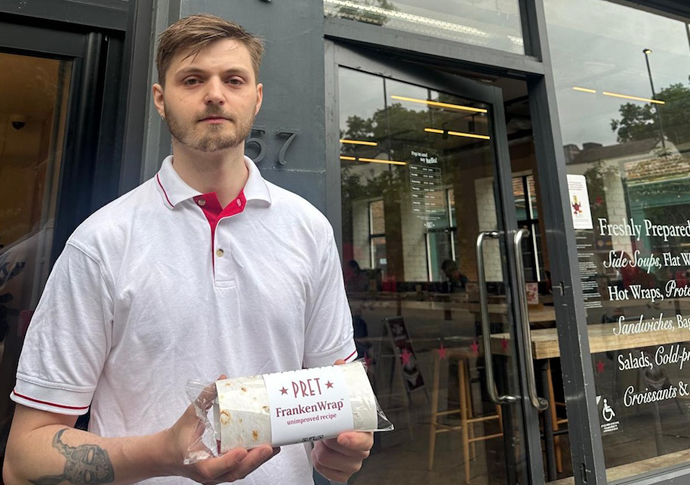
Connor Jackson
“It’s pretty horrifying, but it’s been very effective”, said Mr Jackson. “We wanted to make a photorealistic version of what a Frankenchicken might look like.”
Fast-growing chickens reach a weight of 2.5kg in just 35 days, at which point they are slaughtered. Activists argue that the speedy growth leads to welfare issues, including heart attacks, bone deformities, and organ failure. More than a billion chickens are killed in the UK every year, 90 per cent of which are fast-growing breeds, they say.
Mr Jackson added: “This is an unprecedented campaign. We have a £1million budget. There has never been a budget that big against one particular company about animal welfare.”
A trend towards vegetarianism and veganism has stalled in recent years, and animal rights groups are now co-ordinating efforts to raise concerns about the UK meat industry.
“There was a lot more interest a few years ago, retailers were selling more plant-based than they are now. It’s really hard to sustain that over a long period of time”, said Mr Jackson. “Retailers and places like Pret want to market their chicken because it’s very cost-effective for them. Cheap chicken, for example, is very, very cheap. It’s hard for consumers to have accurate information.”
A spokesperson for Pret said: “We are disappointed that this campaign group has chosen to target one of the few businesses that remains signed up to the Better Chicken Commitment. We already meet five out of the six of those standards and have set a clear roadmap for the remaining one.
“It is unclear to us why activists are spending such significant funds targeting a business trying to do the right thing rather than focusing on those who have abandoned higher welfare reform entirely.
“While we respect the right to peaceful protest and the important issues this campaign seeks to raise, our priority is the wellbeing of our team members and customers. We have plans in place to support them and hope any demonstrations are conducted safely and with respect for the people who work in and visit our shops every day.”
