Prison site development must have place of ‘safety and hope’ for women
Campaigners call on housing association to deliver on centre commitment
Friday, 3rd July — By Finn Logue
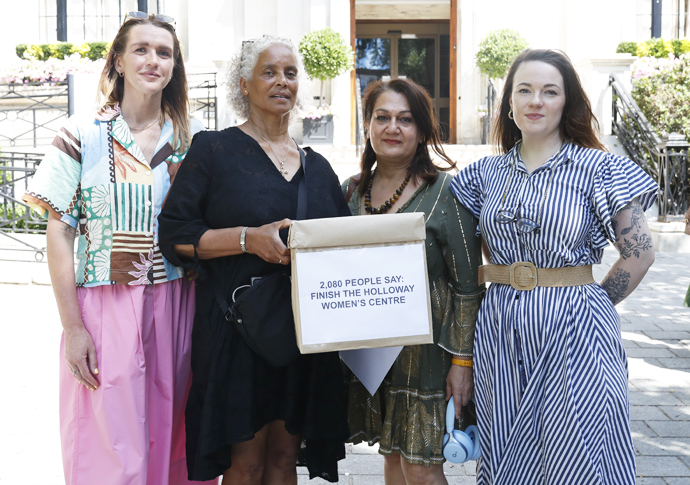
From left: Jade Wye, Mandy Ogunmokun, Gona Saed, and Janey Starling outside the Town Hall [Daniaal Khalid]
CAMPAIGNERS have warned that the legacy of Holloway Prison will be “forgotten and erased” without urgent intervention to deliver the long-awaited women’s centre there.
When the prison shut down 10 years ago, housing association Peabody purchased the land and have since been completing the “Holloway Park” development project, which is made up of around 1,000 homes.
But Peabody also committed to building a women’s centre, which would deliver early intervention services to vulnerable women in Islington and beyond.
The walls for the new centre have been put up, but a dispute is ongoing over who will pay the maintenance and fitting costs, as well as responsibility for running it. Campaigners say that Peabody has told them they “can’t afford” to cover the bill
The cheapest flats in the Holloway Park, meanwhile, will cost £590,000.
The Town Hall is now being urged to intervene and make sure Peabody finises the project and campaigners say, in an open letter, that council chiefs should appoint a representative to oversee a long-term funding plan.
“There’s been a bit of assumption between Islington Council and Peabody that the other will take responsibility, but in reality neither of them want to take it,” Mandy Ogunmokun, founder of the charity Treasures Foundation, told the Tribune.
Ms Ogunmokun, a former prisoner at Holloway, has been a leading campaigner for the women’s centre since 2016.
“It feels like they [the council and Peabody] want to erase the prison and its history, erase that it ever existed, ” Ms Ogunmokun said.
“The building is just standing there. We’ve already got the space, so why can’t we just make that work? Unfortunately, it feels like if there wasn’t this small group of voices shouting for this cause, I think it would just be forgotten.”
Jade Wye, the chief of operations at Treasure Foundation, added: “We want Islington Council to take some responsibility back for the project.
“The women’s centre was supposed to be a place of safety, of hope, of wellbeing and of prevention – but it’s all just been put on the back-burner.”
In 2022, the campaign received support from some members of the council, who issued an obligatory “Section 106” ruling, meaning Peabody were legally bound to complete the construction work.
Janey Starling, co-director of feminist campaign group Level Up, said: “I don’t know what Peabody’s motivations are to continue dragging this out, but it is up to the council to hold them to account. The Section 106 ruling is only as good as the council who enforce it. We’ve lost a lot of momentum on this, but we can’t afford to. It’s easy for people to overlook women who are at the sharpest edge of society.”
Labour councillor Jason Jackson, Islington’s housing chief, said: “The Women’s Building at Holloway Park is a required part of the planning permission and remains a priority. Construction of the building is progressing as part of the wider development, and we remain committed to ensuring Peabody address the clear obligations set out in the Section 106 agreement.
“These require Peabody to take relevant steps to secure funding for the fit out and to identify an appropriate operator, and the council continues to engage with them and monitor progress against this.
“It is not the case that this work has slipped down the council’s priority list or that responsibility is being avoided.
“The agreed process is still under way, with Peabody as the lead organisation at this stage.”
A Peabody spokesperson said: “We’re committed to the Women’s Building and to creating a lasting, positive legacy on the site of the former prison.
“We’re providing a Women’s Building in line with our planning obligations, and as agreed with Islington Council, our role is to deliver the building itself, while working with partners to secure funding and arrangements for internal fit-out and long-term operation of the space. To do this effectively, it is important to identify a suitable, credible operator and put the right arrangements in place, as funders will need confidence that the building will be used, managed and run sustainably over the long term.
“This is a complex and ambitious project, but our intention has always been to honour the history of the site and support women through a safe, welcoming and trauma-informed space.”
